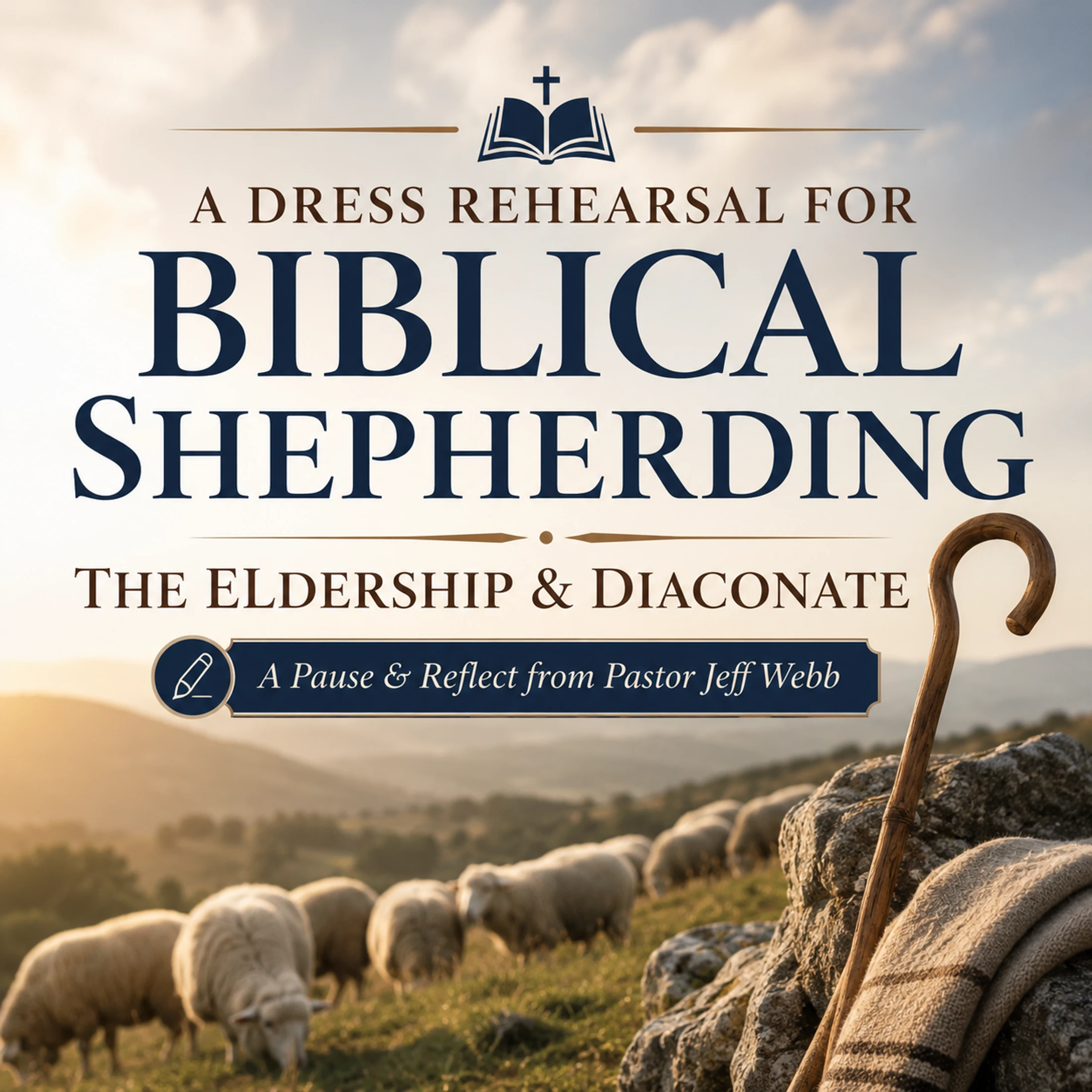
A Dress Rehearsal
“Do not be conformed to this world, but be transformed by the renewal of your mind, that by testing you may discern what is the will of God, what is good and acceptable and perfect.”
(Romans 12:2, ESV)
One of the greatest blessings of Grace Bible Church is the genuine love our church family has for one another. For decades, faithful men and women have prayed together, visited the sick, encouraged the discouraged, welcomed newcomers, and quietly met countless needs behind the scenes. That spirit of love did not begin yesterday, and it certainly did not begin with me. It is a reflection of God's gracious work in this church, and the glue that has held us together for 68 years (est. 1958). I thank Him for it and for you.
With that blessed history in our rearview mirror, every healthy church should repeatedly ask one important question:
How can we continue to conform ourselves even more closely to Christ and his will for his church called Grace Bible Church?
That has been the heart behind our many months of study on biblical church leadership. Our desire has never been to adopt a new trend or replace one tradition with another.
Rather, our desire is to understand God's design for His Church and, with humility, conform ourselves to it.
The question before us is not whether Grace Bible Church loves its people. I believe we do, abundantly.
The question is whether we are willing to continually conform ourselves—and our church—to the pattern God has revealed in His Word. We believe that every step of obedience places us in a better position to experience God's blessing and equips our church to carry out His mission with greater faithfulness and effectiveness.
The New Testament consistently presents two complementary servant-leadership roles within the local church. Elders are called to shepherd, oversee, protect, teach, and care for the spiritual well-being of God's people (Acts 20:28; 1 Peter 5:1–4; Titus 1:5–9).
Deacons are called to serve by removing practical barriers so that shepherding can flourish (Acts 6:1–7; 1 Timothy 3:8–13). Members of the church are called to care for one another (1 Peter 4:8-10; Galatians 6:2; 1 Thessalonians 5:11; Romans 12:10; Philippians 2:4; Hebrews 10:24-25). All three, working together, create a church that is both spiritually healthy and well cared for.
Today, Grace Bible Church operates under a congregational form of governance. Our congregation retains the final earthly authority under Christ, while our elected Diaconate and a congregationally elected Board of Governors, faithfully provides leadership and oversight within that constitutional framework. We continue to respect that structure completely, and nothing about this present season changes it.
What we are exploring is not merely who governs the church, but, just as importantly, how we can most faithfully shepherd and care for the people God has entrusted to us, while also identifying those who have willingly committed themselves to this local body according to the pattern of Scripture.
Because our constitution presently recognizes only one elected leadership body, our current Board (made up of Deacons and church officers) will begin intentionally serving in ways that reflect both the shepherding ministry Scripture assigns to elders and the servant ministry Scripture assigns to deacons. In many respects, these men have already been doing much of this work. What is changing is not their heart, but our intentionality toward service to the body.
Think of it as a dress rehearsal.
A dress rehearsal is not the performance. It is an opportunity to prepare, learn, refine, and grow before the final presentation. During this season we hope to discover what works well, where adjustments need to be made, and how we can best care for our church family according to biblical principles. While we do that, we will be looking to you for feedback and biblical counsel as the Holy Spirit leads you.
One of the practical questions we've begun discussing is, among those who come to our church at any given time--Who receives this level of shepherding care?
Scripture describes elders as shepherds who are entrusted with a particular flock (Acts 20:28; 1 Peter 5:2). While every person who walks through our doors deserves kindness, compassion, and genuine love, shepherds also bear a unique responsibility and accountability to God for those who have intentionally identified themselves with the local body.
That is one of the beautiful purposes of church membership.
Membership is not merely having your name on a list. It is a covenant relationship in which believers publicly identify with Christ’s local church, and that church commits itself to intentionally shepherding, encouraging, protecting, praying for, and caring for them.
As we begin this time of testing and feedback, we also recognize that Grace Bible Church has many faithful attenders who have worshiped, served, and sacrificed alongside us for years but have never formally become members. We deeply value these brothers and sisters, and we are prayerfully discussing how they can continue receiving intentional shepherding care while also encouraging them to consider taking the next step of membership.
Likewise, every guest and every new family who enters our doors matters deeply to us. We want every person to experience the love of Christ through genuine hospitality, meaningful relationships, and compassionate care. As those relationships grow, we hope to walk alongside them through an intentional assimilation process that helps them become fully connected to the life and ministry of Grace Bible Church and, Lord willing, toward membership within our church family.
This is one of the reasons we believe this season is so valuable.
God has already revealed in His Word how He desires His church to be organized and shepherded. Our purpose during this season is not to determine whether His design is good, but to learn how we can best implement that design within the unique life and history of Grace Bible Church.
When the time comes for the congregation to consider any future constitutional changes, we will not simply be discussing ideas we have read about or theories we hope might work.
We will have experienced them together.
Our prayer is that, by God's grace, we will have seen stronger relationships built, more consistent shepherding, quicker responses to needs, deeper prayer, greater accountability, better listening to the concerns of the body of Christ, and a more personal level of care throughout our church family.
If that happens, when the congregation is eventually asked to consider whether our constitution should permanently reflect the biblical pattern of elders and deacons, the question will no longer be, "Will this work?"
Instead, the question will simply be, "Will we permanently conform our structure to the pattern God has already given us in His Word?"
That is our desire—not because the church has failed, but because every faithful church should continually seek to grow by conforming itself more closely to the wisdom of its Chief Shepherd, Jesus Christ.