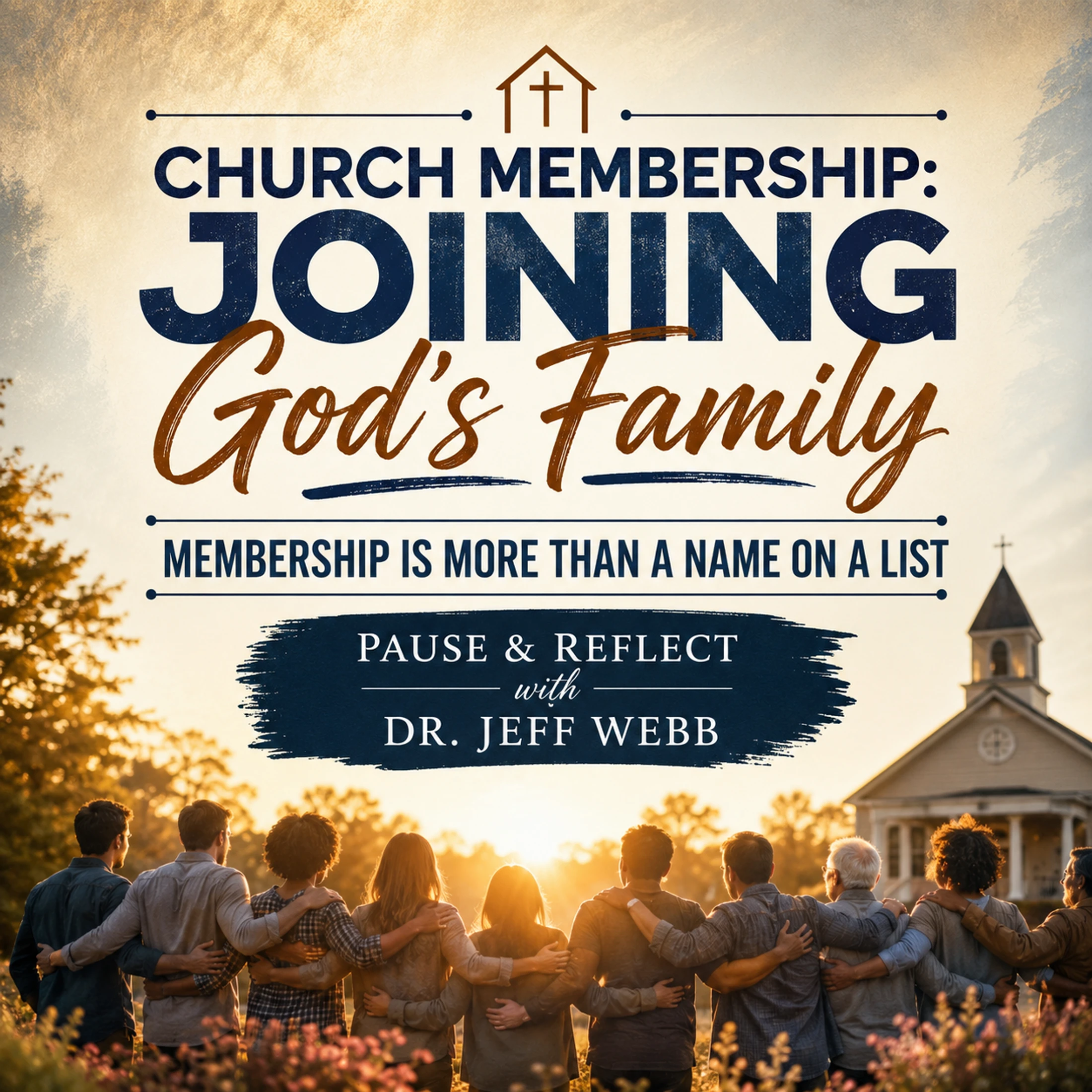
Church Membership: Joining God's Family
In our culture, membership has become a consumer transaction. We purchase memberships at gyms, warehouse clubs, streaming services, and organizations because of the benefits they provide. If the benefits diminish, we simply cancel our membership and move on.
The New Testament presents a completely different picture in the context of church membership.
Church membership is not about receiving benefits. It is about belonging to a family. The Bible commands every believer to join a local family to do the larger work of God. Sadly, this is a totally foreign concept in the modern church today.
It is a victory for the enemy.
All throughout Scripture, God displays his church as a tribe (Old Testament) or family (New Testament).
What Membership Is and Isn’t
When a person joins a local church, he or she is not becoming "more saved," nor earning greater favor with God. Salvation comes by grace alone through faith alone in Jesus Christ (Ephesians 2:8–9). Likewise, baptism publicly identifies us with Christ in His death, burial, and resurrection. Church membership serves a different purpose altogether.
Membership is our public declaration that we have chosen to walk alongside a particular family of believers—to worship together, serve together, grow together, care for one another, and carry out Christ's mission together.
The New Testament assumes this kind of committed relationship. Elders know the flock they shepherd (Hebrews 13:17). Believers bear one another's burdens (Galatians 6:2). Spiritual gifts are exercised for the good of one another (1 Corinthians 12). The early church devoted themselves to life together (Acts 2:42–47).
Membership simply gives visible expression to that biblical commitment.
Family Members Belong to One Another
One of the beautiful truths of the gospel is that God does not merely save individuals— He adopts them into a family.
Throughout Scripture the church is called the Body of Christ, the household of God, a holy nation, and a chosen people. These are not organizational terms. They are family terms.
Healthy families know one another. They celebrate life's joys together. They mourn together. They pray together. They forgive one another. They encourage one another through seasons of victory and seasons of struggle.
Church membership is saying, "These are my people."
In an increasingly isolated culture, that commitment has never been more important.
Family Members Serve One Another
Every member of Christ's family has been uniquely gifted by the Holy Spirit.
Paul compares the church to the human body. Every part matters. Every part contributes. Every part depends upon the others.
Some teach.
Some encourage.
Some lead.
Some show mercy.
Some organize.
Some quietly serve behind the scenes.
The goal is never personal recognition but mutual strengthening.
Healthy churches are not built upon a few exceptionally gifted people.
Healthy churches flourish when every member asks, "Lord, how have You equipped me to strengthen this family?"
Membership is not finding a place to sit.
It is discovering a place to serve.
Family Members Worship Together
Healthy families spend time together.
God's family gathers regularly to worship because worship shapes us into the people Christ desires us to become.
Corporate worship is far more than attending a weekly event. It is where we hear God's Word together, sing His praises together, celebrate communion together, pray together, and encourage one another toward love and good works.
The writer of Hebrews reminds believers not to neglect meeting together, because every gathering strengthens the entire body (Hebrews 10:24–25).
Certainly, illness, travel, work responsibilities, and emergencies sometimes prevent us from gathering. Yet faithful worship remains the normal rhythm of a healthy Christian life because families naturally desire to be together.
Family Members Share the Mission
Jesus never intended ministry to belong only to pastors, elders, or ministry leaders.
The mission belongs to the entire family.
Every member represents Christ in the workplace, the neighborhood, the classroom, and the home.
Every member participates in making disciples.
Every member has opportunities to welcome guests, mentor younger believers, care for the hurting, support missionaries, pray faithfully, and demonstrate Christ's love in practical ways.
Some ministries are visible.
Many are not.
Yet every act of service advances the mission Christ entrusted to His church.
Healthy members do not ask, "What can my church do for me?"
They ask, "How can I help my church accomplish Christ's mission?"
Family Members Steward God's Resources
Perhaps nowhere does our culture differ more sharply from biblical thinking than in the area of finances.
Our world teaches ownership.
Scripture teaches stewardship.
Everything we possess ultimately belongs to God.
Our homes.
Our abilities.
Our time.
Our influence.
Our finances.
None of these truly belong to us. In a similar way to how Joseph was put in full charge of all of Pharoah’s wealth and people, we too, are given the joy of such a lofty position. And while Joseph got to share in a lifestyle of the Pharoah, we all share in the lifestyle of our King. Notice I didn’t say wealth. Lifestyle. Not all people are called to wealth, but their joy and burdens are the same, just in different contexts.
Like Joseph, we are simply managers entrusted with resources that remain His.
That changes the question entirely.
The New Testament never asks, "How much of your money belongs to God?"
It asks, "Since all of it belongs to God, how will you faithfully manage what He has entrusted to you?"
Tithes: Caring for the Family
Under the Old Covenant, God established tithes to sustain the worship of Israel, provide for those who served in ministry, and care for the needs of His covenant people. The prescribed tithes reflected a timeless truth: everything belongs to the Lord.
Jesus did not lower that standard.
He elevated it.
Rather than calling His disciples merely to calculate percentages, He called them to surrender their entire lives—including every resource under their stewardship—to His Lordship.
For that reason, I believe Christians should view the tithe less as a mathematical obligation and more as accepting joyful responsibility for the ongoing life and ministry of their church family.
Healthy families willingly provide for the needs of the household.
Likewise, healthy church members gladly support the ministry of their local church—its pastors and staff, missionaries, ministries, facilities, and outreach—not because they are paying dues, but because they are caring for the family God has called them to love.
Giving is no longer simply about ten percent.
It becomes an expression of faithful stewardship and loving responsibility.
Offerings: Going Beyond Responsibility
Offerings are something different.
If tithes represent our ongoing responsibility to the family, offerings represent the extraordinary generosity of God prompted in us by the Holy Spirit.
Throughout Scripture, God often moved His people to give beyond what was expected.
Sometimes it was to relieve suffering.
Sometimes it was to expand ministry.
Sometimes it was simply an act of extravagant worship.
The New Testament repeatedly reminds us that God loves cheerful givers because generosity reflects His own heart.
There are moments when the Lord may impress upon us to support an emergent need of one of our missionaries, meet the unexpected need of a struggling family, provide for a ministry opportunity, or quietly bless someone in ways no one else will ever know.
Such gifts may stretch us.
They may even require sacrifice.
Yet these are often the moments when stewardship becomes worship.
The Christian life is never measured by the minimum we are willing to give.
It is measured by our willingness to faithfully manage everything God has entrusted to us for His glory.
Living as God's Family
Healthy families rarely ask, "What is the least I have to do?"
Instead they ask, "What does our family need?"
That is the heart of biblical church membership.
We belong.
We worship.
We serve.
We participate in Christ's mission.
We faithfully steward God's resources.
Not because membership earns God's favor.
Not because the church demands it.
But because Christ has adopted us into His family, entrusted us with His mission, and invited us to participate in His work.
May our churches never become collections of religious consumers.
May they increasingly become families of faithful disciples who joyfully give themselves—and everything entrusted to them—to the Lord who first gave Himself for us.