Deacons: Barrier Busters
By Dr. Jeff Webb
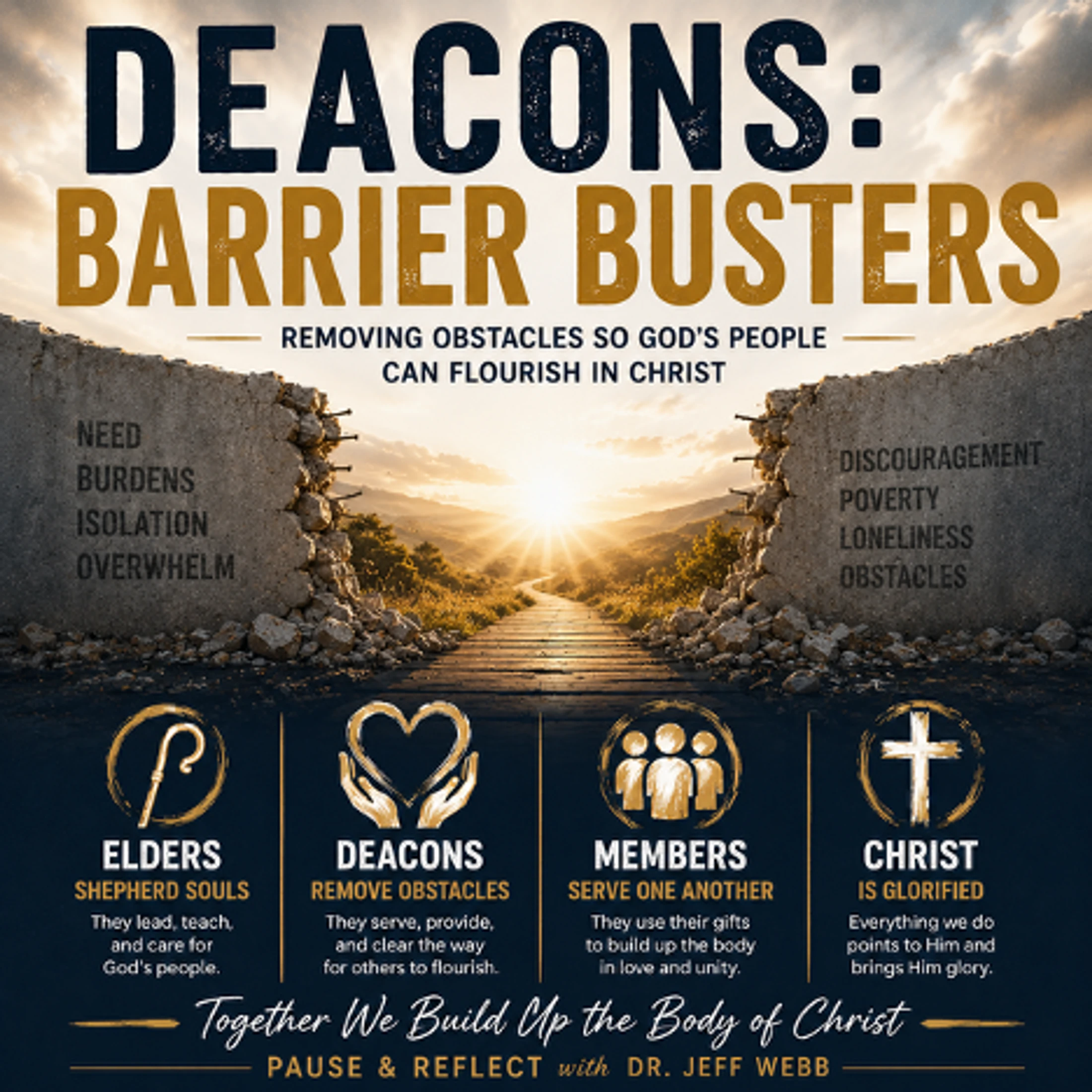
"Elders shepherd souls. Deacons remove obstacles. Together they help God's people flourish."
In the first article of this series, we explored the biblical role of elders as shepherds—not CEOs, executives, or corporate managers. Their calling is to care for souls through prayer, teaching, spiritual oversight, and discipleship.
But God never intended elders to carry the entire ministry of the church alone.
In His wisdom, He established a second office alongside elders: the office of deacon.
Unfortunately, many churches have lost sight of the biblical purpose of deacons. Some view them as board members. Others see them as trustees, committee chairpersons, or administrators. While deacons may assist in many practical aspects of church life, the New Testament presents a much richer picture.
Deacons are servants appointed by God to remove barriers that hinder God's people from flourishing in Christ.
If elders shepherd the flock, deacons help clear the path.
Together they form a God-designed partnership that allows the church to thrive.
Why the Apostles Established Deacons
The office of deacon was born out of a ministry challenge in the early church.
Acts 6 records that the number of disciples was increasing rapidly. With that growth came new needs. A complaint arose because certain widows were being overlooked in the daily distribution of food.
At first glance, the problem appears logistical. In reality, it was spiritual.
The unity of the church was being threatened. Vulnerable people were being neglected. The apostles were increasingly pulled away from the responsibilities God had uniquely entrusted to them.
The apostles responded:
"It is not right that we should give up preaching the word of God to serve tables." (Acts
6:2)
This statement was not a criticism of serving. Jesus Himself came as a servant.
Rather, the apostles recognized that different people had been called to different responsibilities within Christ's body.
They continued:
"But we will devote ourselves to prayer and to the ministry of the word." (Acts 6:4) Their solution was not to ignore the problem.
Nor was it to abandon their primary calling.
Instead, they appointed seven spiritually mature men to oversee the ministry need. The result was remarkable:
"And the word of God continued to increase, and the number of the disciples multiplied greatly..." (Acts 6:7)
When barriers were removed, ministry flourished. The principle remains unchanged today.
What Is a Deacon?
The Greek word diakonos simply means servant or minister. That simplicity is important.
The New Testament never presents deacons as a ruling board.
It presents them as trusted servants who strengthen the ministry of the church.
Paul's qualifications for deacons in 1 Timothy 3 focus overwhelmingly on character rather than technical ability.
Deacons are to be dignified. Trustworthy.
Faithful.
Self-controlled. Spiritually mature.
Proven servants.
Why?
Because the office is not fundamentally about managing things. It is about serving people.
More importantly, it reflects the character of Christ Himself.
Throughout His earthly ministry, Jesus consistently removed barriers that kept people from experiencing the love and truth of God. He touched lepers whom society rejected. He welcomed children whom others considered interruptions. He fed hungry crowds. He comforted the brokenhearted. He restored those pushed to the margins.
Jesus cared deeply about spiritual needs, but He never ignored practical needs. Neither should His church.
In many ways, deacons continue this ministry pattern. Through their service, they help ensure that burdens, obstacles, and unmet needs do not prevent God's people from fully participating in the life of Christ and His church.
Deacons as Barrier Busters
One helpful way to understand the ministry of deacons is to think of them as "Barrier Busters."
Throughout church life, obstacles arise that hinder believers from growing, serving, worshiping, and connecting with others.
Some barriers are physical.
A widow cannot maintain her home.
An elderly member needs transportation. A family faces a financial crisis.
A facility issue limits ministry opportunities. Some barriers are emotional.
A grieving family feels isolated.
A struggling member needs encouragement.
A newcomer feels disconnected. Some barriers are organizational. Communication breaks down.
Resources are not coordinated. Important needs go unnoticed. Ministry opportunities are missed.
In each case, deacons step into the gap. They identify needs.
Organize solutions. Mobilize resources. Coordinate care.
Connect people with help.
Their work often happens behind the scenes, but its impact is felt throughout the congregation.
The goal is not simply solving problems. The goal is helping people flourish in Christ.
The Partnership Between Elders and Deacons
One of the most common mistakes churches make is confusing the roles of elders and deacons.
When deacons become spiritual overseers, confusion follows.
When elders become consumed by practical administration, shepherding suffers. The New Testament presents a beautiful partnership instead.
The apostles recognized in Acts 6 that both spiritual leadership and practical ministry were essential to the health of the church. Rather than forcing one group to do everything, God established a structure that allowed ministry to multiply.
Elders Focus On:
- Prayer
- Teaching
- Spiritual leadership
- Shepherding
- Discipleship
- Protecting doctrine
Deacons Focus On:
- Practical care
- Service ministries
- Resource stewardship
- Congregational support
- Removing obstacles
- Facilitating ministry Neither role is more important. Both are necessary.
The church needs shepherds. The church needs servants.
The church needs leaders who care for souls and servants who help remove the obstacles that burden those souls.
Together they reflect Christ, who is both the Good Shepherd and the Servant King.
Why Deacons Are Not Optional
Some churches can survive without a biblical deacon ministry. Few can thrive without one.
The question is not whether a church can continue holding services on Sunday morning.
The question is whether it can function as Christ intended. As churches grow, needs multiply.
Families experience crises.
Members face illness, grief, financial hardship, loneliness, transportation challenges, and countless other burdens.
At the same time, elders remain responsible for prayer, shepherding, teaching, discipleship, and spiritual oversight.
God's answer was never that a few leaders should simply work harder. His answer was shared ministry.
Acts 6 reveals a timeless principle: healthy churches require servant leaders who intentionally remove barriers that hinder people from flourishing in Christ.
Without faithful deacons, practical needs often go unmet. Without faithful elders, spiritual guidance weakens.
But when both offices function as God intended, the church experiences comprehensive care.
Souls are shepherded. Needs are addressed. Unity is strengthened. Ministry expands.
This is why biblical governance is not primarily about authority. It is about care.
A Church Organized Around Care
The New Testament does not present church leadership as a hierarchy of power.
It presents a family of servants working together for the glory of God and the good of His people.
A church governed according to God's design is not obsessed with titles, positions, or control.
It is organized around care.
Elders help ensure that no soul is neglected.
Deacons help ensure that no need is ignored.
Members use their gifts so that no ministry is left undone.
When every part functions according to God's design, the church becomes healthier, stronger, and more effective in its mission.
The same result that followed the appointment of the Seven in Acts 6 continues to follow faithful servant leadership today.
The church is strengthened. The people are cared for.
And the Word of God advances.
That is why deacons remain not merely relevant, but necessary.
They are not administrators first.
They are not committee chairpersons first.
They are not trustees first. They are servants of Christ.
Barrier Busters.
Men who help remove obstacles so that God's people can more fully experience communion with Him and with one another in the Body of Christ.