Family Living: Becoming Members of God's Family, the Church
Why Belonging to a Local Church Is God’s Plan for His People
One of the more common ideas in modern Christianity goes something like this: “I’m already a member of the family of God because I’ve been saved. Why do I need membership in a local church?” At first glance, that may sound reasonable. After all, salvation is by grace through faith, not by signing a card, standing before a congregation, or placing one’s name on a roll.
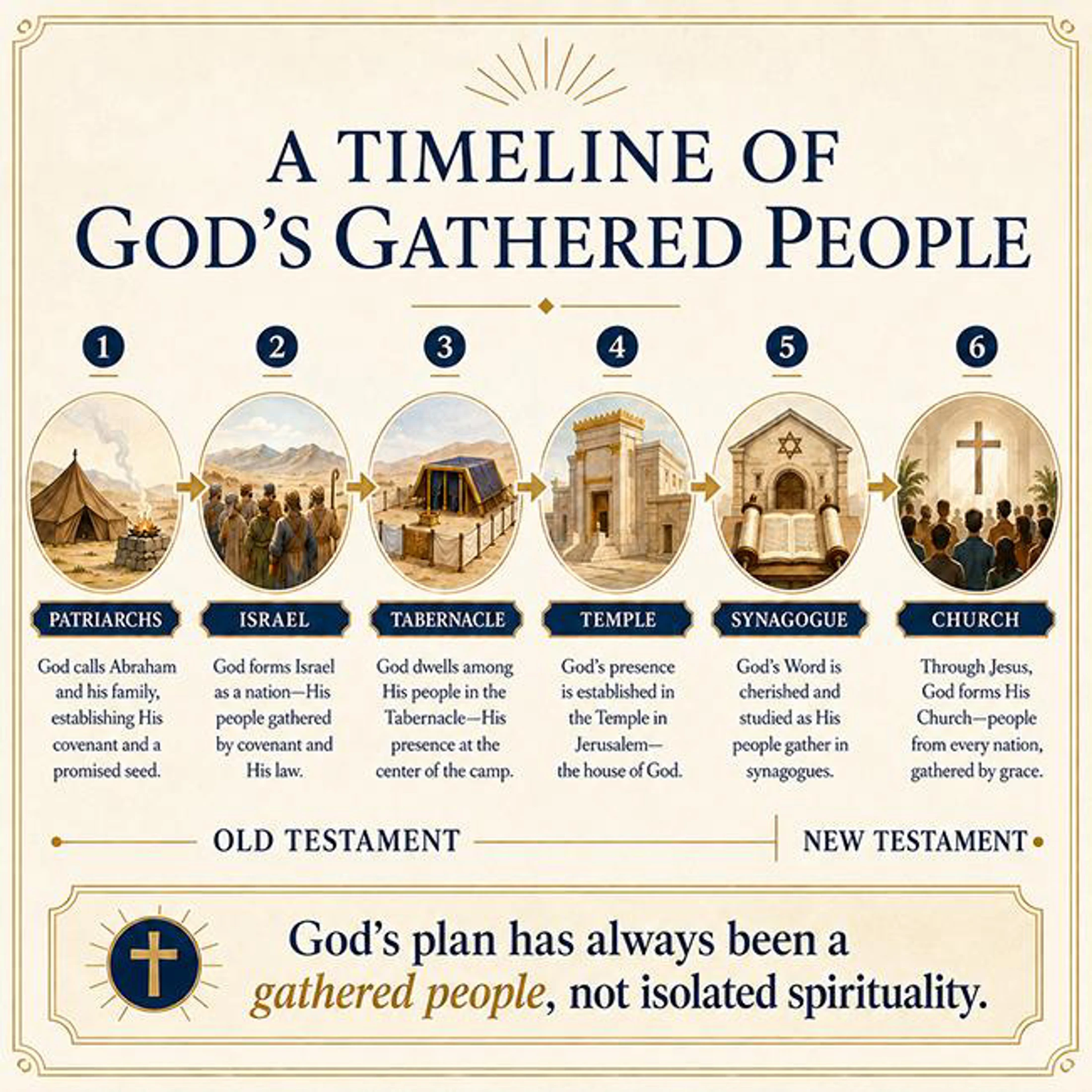
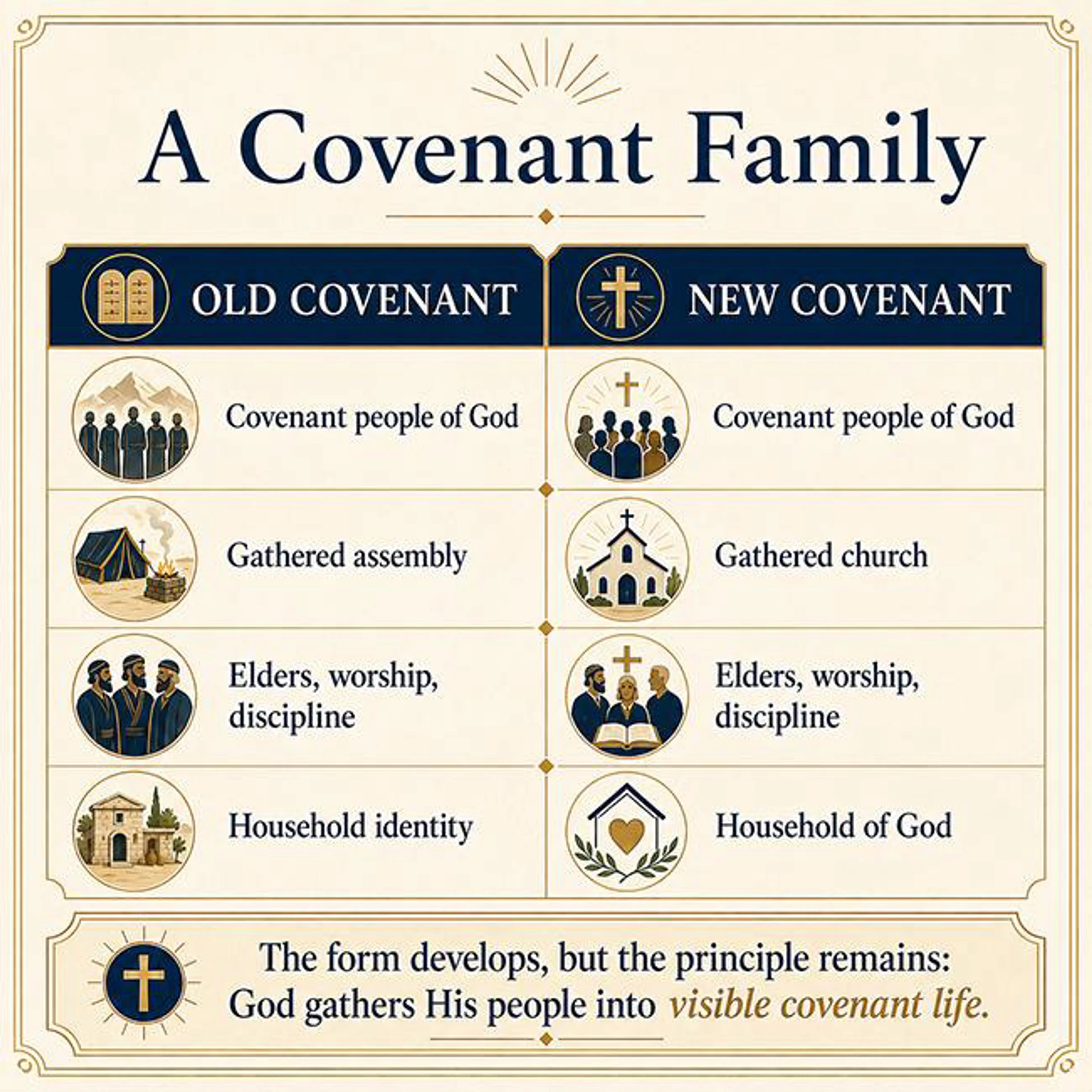
And yet, while local church membership does not save anyone, Scripture consistently presents something many modern believers have forgotten: God’s people are not merely saved into a private relationship with Him; they are gathered into a visible, ,accountable, worshiping family. From the Old Testament to the New, the pattern is strikingly stable. God’s plan has always been to call out a people for Himself, and that people have always had a real, identifiable life together.
The word membership may be expressed differently across the biblical storyline, but the reality it describes is woven into the fabric of redemption history. To belong to God has always meant, in some meaningful and recognizable sense, belonging to God’s people.
In the Old Testament, God Gathered a People, Not Merely Isolated Believers
From the beginning, God’s redemptive work was corporate as well as personal. He did not simply call random individuals into disconnected acts of devotion. He formed a people.
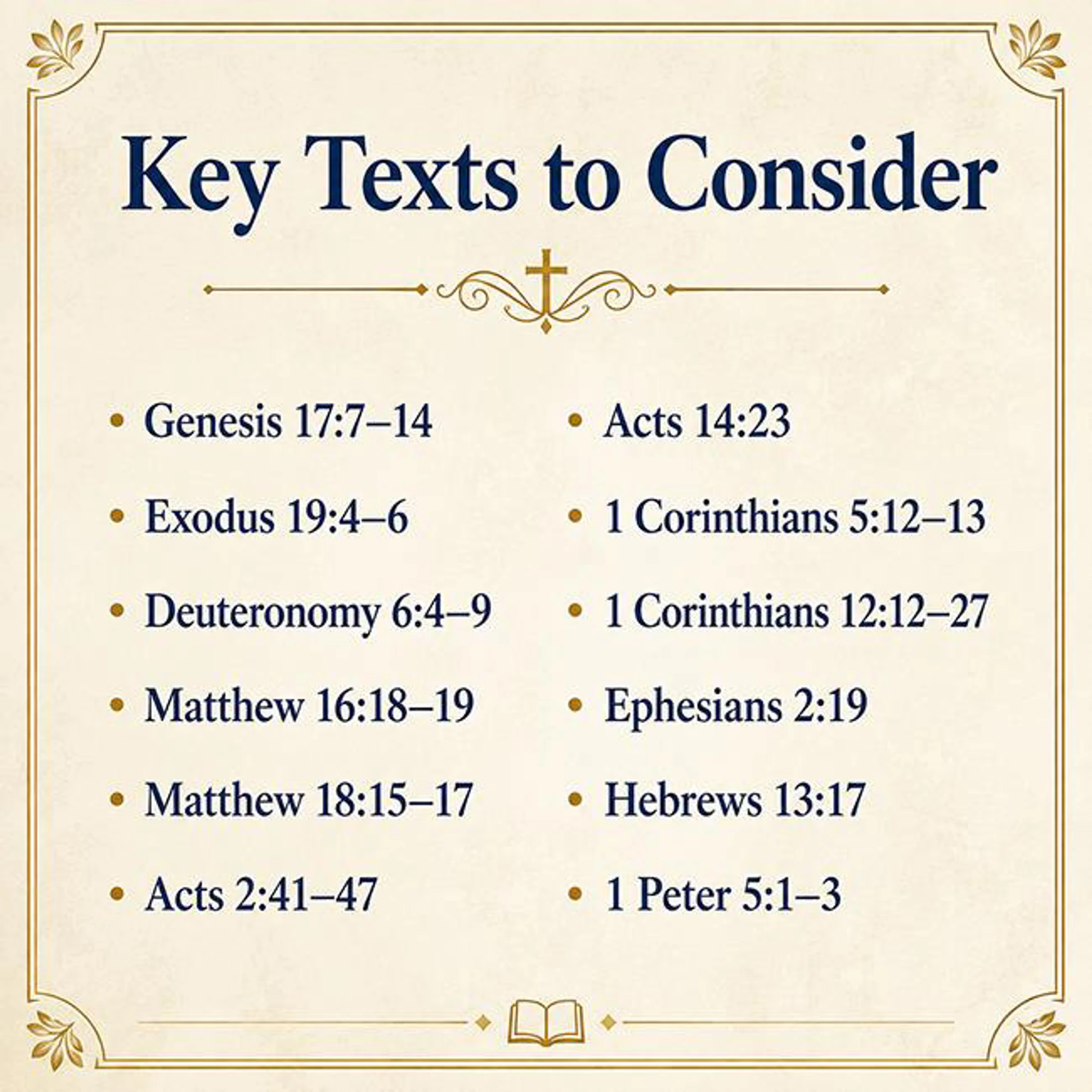
When God called Abraham, He did not merely promise to save one man in private. He promised to make of him a great nation (Gen. 12:1–3). The covenant sign of circumcision was given not only to Abraham personally, but to his household and descendants (Gen. 17:7–14). In other words, the covenant was never merely an invisible spiritual sentiment. It created a recognizable covenant people.
That pattern only became clearer in Israel. The Lord redeemed a people out of Egypt and brought them to Himself at Sinai (Ex. 19:4–6). He did not establish a religion of independent spirituality. He constituted Israel as His covenant assembly, His treasured possession, His “kingdom of priests and a holy nation.” Families, tribes, elders, priests, and the congregation all had defined places within the life of the people of God.
Even before worship was centralized in Shiloh and then Jerusalem, the people of God practiced household worship and visible covenant life. Altars were built, sacrifices were offered, feasts were observed, and children were taught the mighty acts of God (Deut. 6:4–9; Josh. 4:20–24). Later, with the tabernacle and then the temple, corporate
worship became even more structured. God’s people gathered, offered sacrifices, heard the Law, and lived under covenant obligations together.
This is important: the Old Testament does not present belonging to God as a merely inward matter. It was inward, yes—but it was never only inward. It was embodied in a people.
Covenant Life Included Recognizable Belonging, Responsibility, and Accountability
Some object that the Old Testament says nothing about “membership” in the modern sense. That is true—at least if by membership we mean a printed directory or a formal class. But if we mean recognizable belonging to a covenant community, then the concept is everywhere.
Israel knew who belonged to the covenant people and who did not. Genealogies mattered. Households mattered. Tribal identity mattered. Participation in covenant signs and feasts mattered. Elders represented the people. The assembly could gather. The people could be counted. Some could be received, and some could be “cut off from among the people” because of covenant rebellion (Ex. 12:15; Lev. 17:4; Num. 15:30–31). One cannot be cut off from a people unless there is first a people to which one belongs.
This shows that covenant life carried both privilege and responsibility. God’s people worshiped together, rejoiced together, mourned together, fought together, and bore the consequences of sin together. Their identity was not merely “I know the Lord,” but also “I belong among the Lord’s people.”
Even in the synagogue system that developed in Jewish life, especially by the time of Jesus and the apostles, the principle remained. Local worshiping communities had recognized leaders, regular gatherings, instruction in the Scriptures, discipline, and care for the needy. That is why, on his missionary journeys, Paul typically went first to the synagogues (Acts 13:14; 14:1; 17:1–2; 18:4). The synagogue was not the church, but it reflected the longstanding conviction that God’s people ordinarily lived out their faith in defined worshiping communities."

Jesus Did Not Abolish the Family Concept—He Fulfilled and Deepened It
When we come to the New Testament, Jesus does not undo this pattern. He fulfills it and brings it to its intended goal.
Jesus spoke of a flock with a shepherd (John 10:1–16). He called His disciples a family, saying, “Whoever does the will of my Father in heaven is my brother and sister and mother” (Matt. 12:49–50). He announced that He would build His church (Matt.
16:18). He spoke of a community that would possess authority to bind and loose (Matt. 16:19; 18:18), and He gave instructions for church discipline in Matthew 18:15–17.
That passage alone is deeply significant. Jesus says that an unrepentant sinner may finally be brought “to the church.” If he refuses to listen even to the church, he is to be treated as an outsider. That language assumes a real, identifiable community with some sense of who belongs within it. Church discipline makes little sense if there is no recognizable church family to which one is accountable.
Jesus was not creating an optional social arrangement for especially committed Christians. He was forming a new covenant people around Himself. This family would not be based on ethnicity, but on faith. Still, it would remain a real family, not merely a mystical abstraction."
In Acts, Salvation Immediately Connected Believers to an Identifiable Church Family
The book of Acts makes this especially clear. When people were converted, they were not left floating in spiritual independence. They were added to a people.
Acts 2 says that those who received the word were baptized, and “there were added that day about three thousand souls” (Acts 2:41). A few verses later we read, “And the Lord added to their number day by day those who were being saved” (Acts 2:47). Added to what? To the gathered body of believers in Jerusalem.
And what did life in that community look like? “They devoted themselves to the apostles’ teaching and the fellowship, to the breaking of bread and the prayers” (Acts 2:42). There was shared life, common worship, sacrificial care, recognized leadership, and ordered ministry.
As the church spread, this same local pattern reappeared. Churches were established in cities. Elders were appointed in every church (Acts 14:23). Deacon servants emerged to meet tangible needs (Acts 6:1–6). Collections were organized for suffering saints (1 Cor. 16:1–4). Widows were enrolled for care (1 Tim. 5:9). Letters were written to specific congregations with particular members, leaders, strengths, weaknesses, and responsibilities.
The church in the New Testament was never merely the universal body of Christ in the abstract. It was also a network of real local assemblies where Christians knew one another, served one another, submitted to leaders, received care, and accepted discipline.
The Epistles Assume Local, Accountable Belonging
The New Testament letters repeatedly assume the reality of local church membership, even if they do not always use that exact modern term.
Paul describes the church as a body in which each member belongs to the others (Rom. 12:4–5; 1 Cor. 12:12–27). A body is not a loose association of disconnected parts. It is an organized, interdependent whole. He also calls the church the household of God (Eph. 2:19; 1 Tim. 3:15). A household is not a random crowd; it is a family with recognized relationships.
Church leaders are told to shepherd the flock of God among them (Acts 20:28; 1 Pet. 5:1–3). Believers are commanded to obey their leaders and submit to them, because those leaders are keeping watch over their souls (Heb. 13:17). That kind of pastoral care assumes mutual recognition. Which leaders? Over whom? For whose souls are they accountable? The text only makes sense if Christians belong to actual, identifiable congregations.
Likewise, Paul distinguishes between those inside and those outside the church in 1 Corinthians 5. He rebukes the Corinthian believers for failing to deal with open, unrepentant sin. “Is it not those inside the church whom you are to judge?” (1 Cor. 5:12). Again, this assumes boundaries—not rigid, loveless bureaucracy, but loving, holy clarity. There is a people who can say, “These are the ones entrusted to our care and fellowship.”
The many “one another” commands of the New Testament point in the same direction. Love one another. Bear one another’s burdens. Encourage one another. Admonish one another. Forgive one another. Serve one another. Spur one another on to love and good works. These commands certainly apply to the wider body of Christ in principle, but they can only be consistently lived out in the context of real, ongoing, local relationships.
So What Is Local Church Membership?
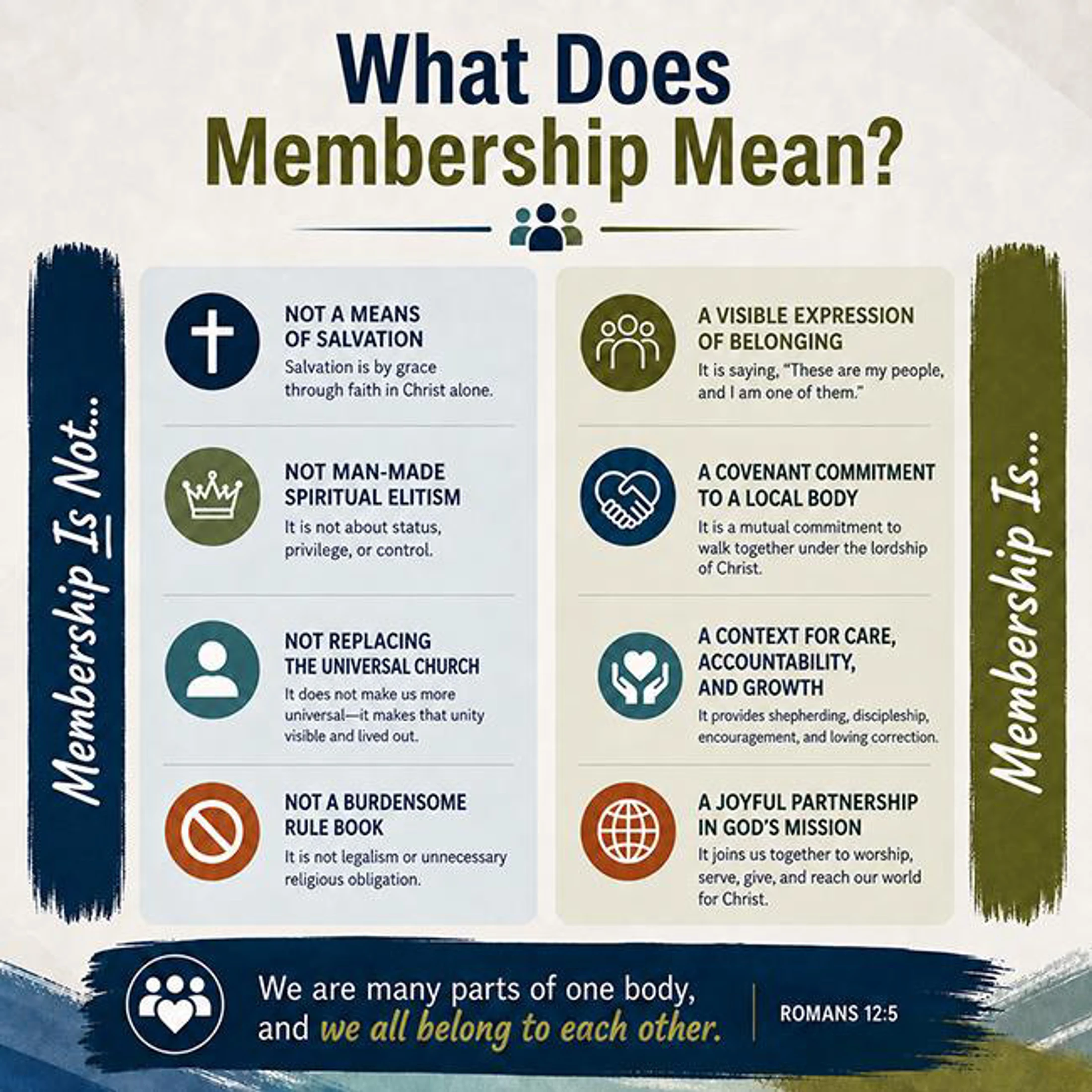
Local church membership, then, is not a human invention designed to burden Christians with unnecessary formality. At its best, it is simply the church’s way of recognizing, ordering, and honoring a biblical reality: God saves us into His family, and that family takes visible form in a local congregation.
Membership does not replace salvation. It does not create the universal body of Christ. It does not make a person more justified before God. Rather, it acknowledges and formalizes what salvation itself creates—belonging, accountability, care, worship, mission, and mutual commitment. T
o say, “I belong to Jesus, but I do not need to belong in any defined way to His people,” is difficult to reconcile with the broad witness of Scripture. The Bible’s vision is fuller, warmer, and more demanding than that. It presents the Christian life not as merely being in relationship to a family, but as actually being part of a family.
And families know who is in the household.
Conclusion: God’s Plan Has Always Been a People
From Abraham’s household to the assembly of Israel, from synagogue life to the gathered churches of Acts, from Jesus’ flock to Paul’s household of faith, the testimony of Scripture is remarkably consistent: God’s plan for His people is not isolated spirituality, but covenant family life.
Yes, every true believer belongs to the universal church. But that glorious truth does not lessen the importance of the local church; it gives rise to it. The universal church becomes visible in local congregations where believers worship, serve, give, pray, grow, submit, restore, and persevere together.
This is why local church membership matters. Not because paperwork saves, but because belonging matters. Commitment matters. Accountability matters. Family matters.
And from the Old Testament to the New, that has always been God’s plan.
Closing Challenge If Christ has saved you into His body, are you living as a committed part of His family? Not merely attending it. Not merely appreciating it. Not merely being in relationship to it. But truly belonging—known, committed, accountable, and joyfully joined to a local church family.