
God on Trial
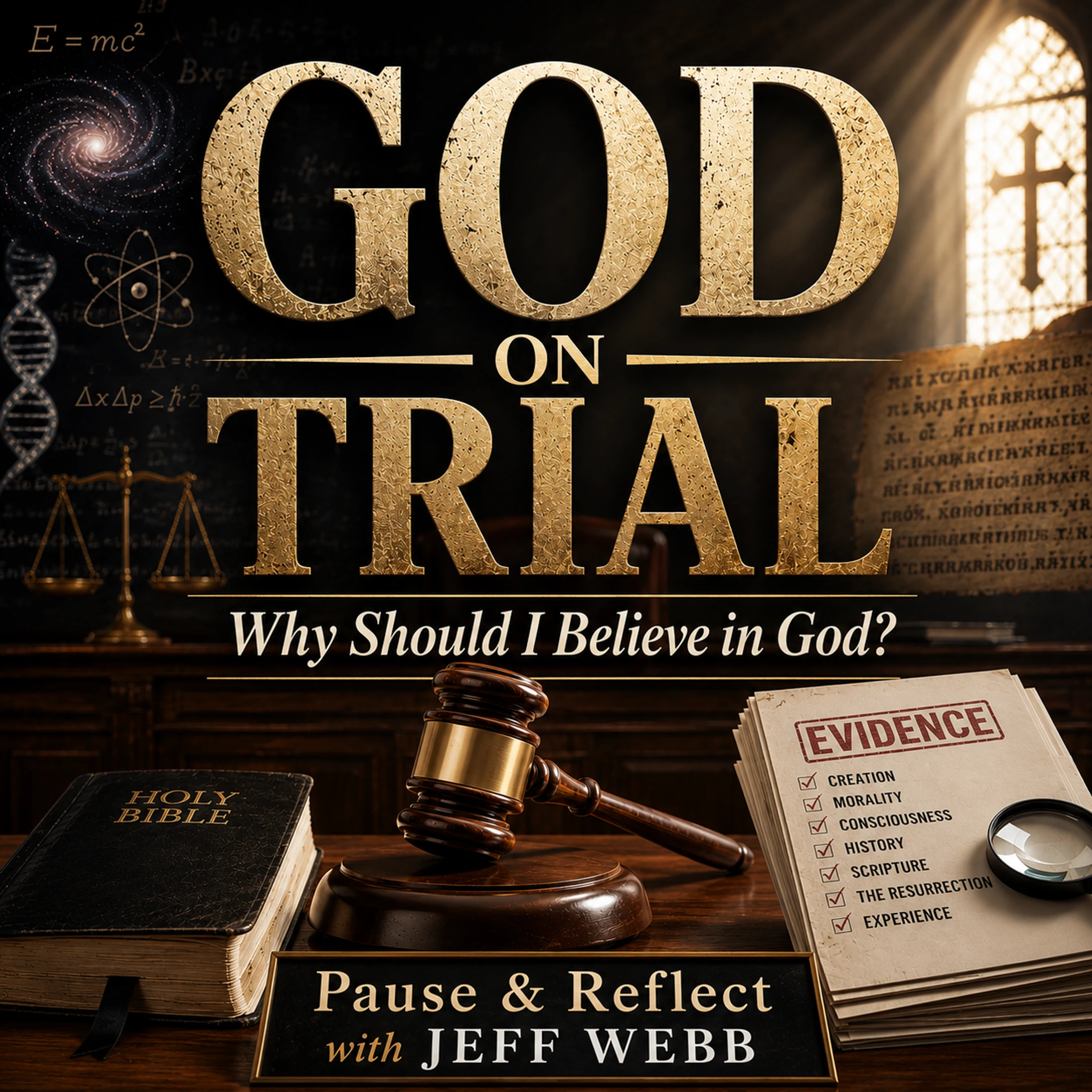
“FaithIsNotaLeapintoDarkness—
It Is a Response to the Light God Has Already Given”
For many people, Christianity is portrayed as though God asks us to switch off our minds and simply believe.
"Just have faith."
Yet that is not how the Bible presents faith at all.
“Now faith is the substance of things hoped for, the evidence of things not seen,”
is the oft quoted verse on faith (Hebrews 11:1. But what is often misunderstood is that in every illustration of faith in Hebrews 11, the person of faith wasn’t employing “blind faith,” they were employing faith that had an inexhaustible trust in the object of their faith—God.
Biblical faith is not believing without evidence. It is trusting the One who has made Himself known.
Throughout Scripture, God never asks people to believe in a vacuum. Instead, He continually points to evidence of His existence and character. He points to creation. He points to history. He points to fulfilled prophecy. He points to miracles. He points to the resurrection of Christ. Then He asks humanity to respond.
As Isaiah records God's invitation:
"Come now, let us reason together..." (Isaiah 1:18)
Christianity is remarkably comfortable with investigation because truth welcomes examination.
No single argument proves God beyond every conceivable doubt. Few important truths in life work that way. Instead, Christianity offers something much stronger: numerous independent lines of evidence that all point toward the same conclusion.
Like strands of a rope, each strengthens the others. (Eccl. 4:12)
The Universe Exists
The first question is not whether science explains how the universe works.
Science has been wonderfully successful at discovering the mechanisms of nature.
The deeper question is far more profound:
Why is there a universe at all?
Everything we observe that begins to exist has a cause.
Modern cosmology strongly indicates that the universe itself had a beginning.
If the universe began to exist, then it cannot ultimately explain its own existence. Whatever caused the universe must exist outside the universe itself.
Outside time.
Outside space.
Outside matter.
Outside energy.
Already we find ourselves describing something remarkably like what Scripture has always described as God.
"In the beginning, God created the heavens and the earth." (Genesis 1:1)
The Universe Is Ordered
Our universe is astonishingly understandable.
Mathematics describes reality with breathtaking precision.
The laws of physics remain consistent across billions of light-years.
The fundamental constants of nature appear exquisitely fine-tuned for life. Even more astonishing is the digital information encoded within DNA. Information is different from matter.
Matter can carry information, but it does not create meaningful information.
Whenever we encounter complex, specified information—a book, computer code, or blueprint—we naturally infer intelligence because information always comes from a mind.
The universe increasingly appears less like a cosmic accident and more like a masterpiece.
As Psalm 19 declares:
"The heavens declare the glory of God, and the sky above proclaims his handiwork."
Objective Morality Exists
Most people instinctively know that certain actions are objectively wrong.
Genocide.
The abuse of children. Human trafficking.
Torture for pleasure.
These are not merely preferences.
They are moral realities.
But objective moral laws require something beyond human opinion.
If morality is simply a product of evolution or culture, then no society can ever truly be wrong—only different.
Yet our hearts revolt against that conclusion.
The existence of objective moral obligations points toward an objective Moral Lawgiver.
As Paul explains, God has written aspects of His law upon the human conscience (Romans 2:14–15).
Human Consciousness
Perhaps the greatest mystery in science remains the human mind. Matter has never been shown to produce consciousness.
Brains process information.
But why should physical processes produce awareness?
Or love?
Or beauty?
Or sacrifice?
Or the longing for eternity?
We are not merely machines calculating survival. We ask questions that atoms never ask.
Why am I here?
What is truth?
What is beauty?
What is love?
Why does life matter?
Ecclesiastes says God has "put eternity into man's heart" (Ecclesiastes 3:11). Our deepest longings seem strangely fitted for something beyond this world.
The Reliability of Scripture
The Bible stands alone among ancient literature. Written over approximately fifteen centuries... through around forty authors...
on three continents... in multiple languages...
it nevertheless unfolds one unified story of God's plan to redeem humanity through Jesus Christ.
Its historical reliability has repeatedly been strengthened through archaeology.
Its fulfilled prophecies remain extraordinary. Its theological unity is unparalleled.
This is not merely one ancient book.
It is a library that tells one coherent story.
The Historical Jesus
Virtually every serious historian agrees on several core facts.
Jesus of Nazareth existed.
He was crucified under Pontius Pilate.
His followers genuinely believed they encountered Him alive after His death. The Christian movement exploded despite severe persecution.
The earliest disciples willingly suffered and often died without renouncing their testimony.
The question is no longer whether these events occurred.
The question becomes:
What best explains them?
The resurrection uniquely accounts for the historical evidence.
As Paul wrote,
"If Christ has not been raised, your faith is futile..." (1 Corinthians 15:17) Christianity stands or falls upon a historical event.
Remarkably, it invites investigation.
Personal Experience Matters—But It Is Not the Foundation
Millions of Christians across every culture and century testify that Christ has transformed their lives.
Their experiences are meaningful.
But Christianity does not ask us to believe because someone had an experience. Rather, personal experience confirms what objective evidence already points toward. The Holy Spirit continues God's work of revealing Himself personally to those who seek Him.
As Jesus promised,
"My sheep hear my voice..." (John 10:27)
When the Evidence Converges
Imagine standing before a great mountain. There are many trails leading upward.
One traveler comes by the path of science.
Another by philosophy. Another through history. Another through morality. Another through beauty. Another through Scripture.
Another through the resurrection. Another through personal experience. Each begins in a different place.
Each follows different evidence.
Yet as they climb, something remarkable happens.
The trails begin to converge.
The higher they climb, the clearer it becomes that they are approaching the same summit.
This is how the evidence for God works.
No single argument compels belief all by itself.
But together they create a cumulative case that becomes increasingly difficult to dismiss.
At some point, the greater leap of faith is no longer believing in God.
It is believing that all these independent lines of evidence happen to point in precisely
the same direction by coincidence.
The Story Keeps Getting Bigger
For generations, some have predicted that every new scientific discovery would eventually eliminate the need for God.
The opposite has happened.
The more we discover about the universe... the more astonishing its order appears.
The more we learn about DNA...
the more breathtaking biological information becomes.
The deeper we study cosmology...
the more profound the question of beginnings grows. The more archaeology uncovers...
the more the historical setting of Scripture is illuminated. Every new discovery does not make God smaller.
It makes the explanation that God exists increasingly larger. The story keeps getting bigger.
Faith Responds to Revelation
The Bible never portrays God as hidden from those willing to seek Him honestly.
He has revealed Himself through creation.
Through conscience.
Through history.
Through Scripture.
Through Jesus Christ.
Through the resurrection.
Through the ongoing work of the Holy Spirit. Faith, then, is not believing without evidence.
Faith is trusting the God who has made Himself known. As Paul told the philosophers in Athens,
"He is actually not far from each one of us." (Acts 17:27)
The invitation of Christianity has never been to close our eyes.
It has always been to open them.