How to Make Godly Decisions
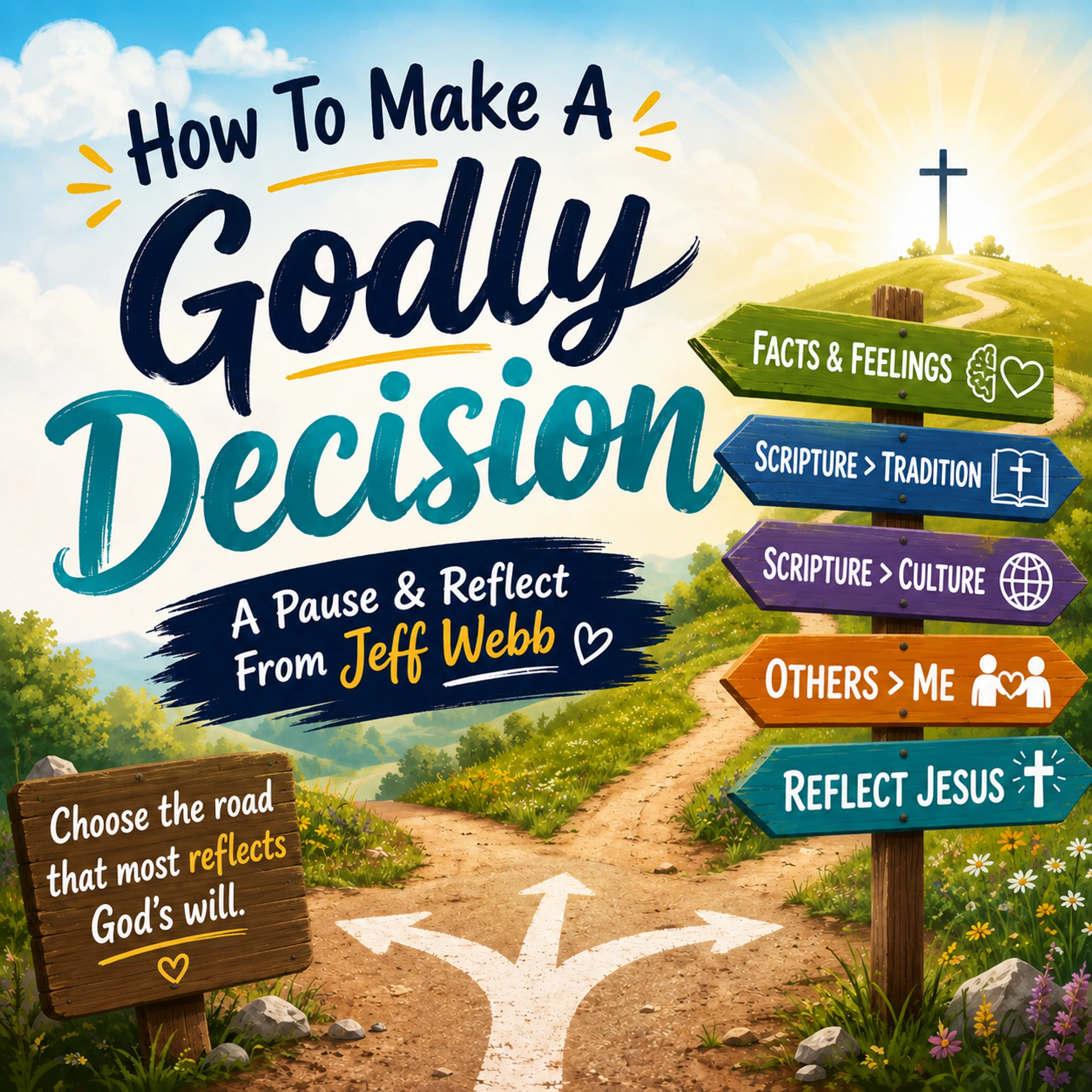
When Facts, Feelings, Culture, and Self All Want a Vote
The acclaimed poet Robert Frost, in his poem The Road Not Taken, gives voice to an ancient and deeply resonant human experience: standing at a crossroads and knowing that the road we choose may shape everything that follows.
Two roads diverged in a yellow wood And sorry I could not travel both
And be one traveler, long I stood
And looked down one as far as I could
To where it bent in the undergrowth;
Then took the other, as just as fair,
And having perhaps the better claim,
Because it was grassy and wanted wear; Though as for that the passing there Had worn them really about the same,
And both that morning equally lay
In leaves no step had trodden black. Oh, I kept the first for another day!
Yet knowing how way leads on to way, I doubted if I should ever come back.
I shall be telling this with a sigh Somewhere ages and ages hence:
Two roads diverged in a wood, and I—I took the one less traveled by,
And that has made all the difference.
There is something wonderfully honest in Frost’s traveler.
He stands there for a long time.
He looks as far down one road as he can. He compares the two.
He tries to determine which is better.
And still, he cannot see where either road ultimately leads.
That sounds remarkably like life.
We make decisions with limited vision.
We gather the facts we can gather. We weigh possibilities. We imagine outcomes. We wonder what might happen if we choose one path instead of another. Yet every road eventually disappears “in the undergrowth.” There comes a point beyond which we simply cannot see.
And Frost recognizes something else that experience teaches all of us:
“Way leads on to way.”
One decision leads to another.
A career choice leads somewhere.
A marriage leads somewhere.
A friendship leads somewhere.
A financial decision leads somewhere.
A church decision leads somewhere.
A word spoken in anger leads somewhere.
An act of generosity leads somewhere.
A choice to forgive—or not forgive—leads somewhere.
We sometimes tell ourselves, I can always come back and take the other road later.
Sometimes we can.
Often, we cannot.
And that is precisely why the Christian approaches the crossroads differently.
The great question is not simply: “Which road do I want to take?” It is not even:
“Which road is less traveled?”
A road is not godly simply because it is unpopular, difficult, unconventional, or rarely chosen.
Nor is a road godly merely because it feels right.
The Christian asks something deeper:
“Which road most faithfully reflects the will, wisdom, and character of God?”
That changes everything.
Because the goal of Christian decision-making is not to predict the future.
We cannot.
It is not to eliminate every uncertainty. We cannot do that either.
And it is certainly not to discover some secret formula that guarantees every decision will produce the outcome we hoped for.
Rather, godly decision-making is learning how to trust in God’s sovereignty and choose faith-fully when we cannot see very far down the road.
Some decisions are easy because God has already spoken clearly.
Should I steal this? No.
Should I forgive someone who has wronged me? Yes.
Should I deliberately deceive someone? No.
Should I love my neighbor? Yes.
But many of the decisions we face are not that simple.
Should I take this job?
Should I confront this person or remain silent?
Should our church continue doing something simply because we have always done it?
Should I give when giving will cost me something?
Should I follow the path that feels safest—or the one that seems most faithful?
In moments like these, Christians sometimes say, “Just pray about it.”
Certainly we should pray.
But prayer is not a substitute for thinking biblically.
In fact, one of the ways God answers our prayers for wisdom is by teaching us to bring our thoughts, emotions, assumptions, traditions, desires, relationships, and motives under the authority of His Word and the leadership of His Spirit.
Perhaps that is the great difference between Frost’s traveler and the Christian standing at the crossroads.
We may not know what lies around the bend.
But we know the One who does.
So how do we make a godly decision?
I believe there are at least three important questions we should learn to ask.
1.Am I Choosing What Is True—or Simply What I Feel?
Our culture frequently tells us:
“Trust your feelings” or “your truth is your truth” (implying our version of truth—which is opinion, actually—is righteous)
Scripture gives us a more careful message.
Our feelings matter. Our conclusions may or may not.
God created us as emotional beings. Compassion moved Jesus. He wept. He rejoiced. He became angry. He experienced anguish. Scripture never portrays emotional maturity as the absence of feeling.
Sometimes our emotions reveal things that our minds have not yet acknowledged. Fear may alert us to danger.
Grief may reveal something we deeply value.
Compassion may awaken us to another person's suffering.
Uneasiness may cause us to stop and ask questions we have been avoiding. Joy may accompany the recognition that we are walking in obedience to God.
Even guilt can be valuable when the Holy Spirit uses it to bring genuine conviction and repentance.
Our feelings are therefore important information. But they are not always reliable instructions.
Jeremiah reminds us:
“The heart is deceitful above all things...”
—Jeremiah 17:9
That doesn't mean every emotion is sinful or deceptive. It means our inner world has been affected by the Fall just as surely as our thinking has.
I can feel rejected when no rejection was intended.
I can feel afraid when there is no real danger.
I can feel justified in anger while being completely wrong.
I can feel peace about something simply because it gives me what I want.
And I can feel terribly uncomfortable while doing exactly what God has asked me to do.
Jesus certainly did in Gethsemane. Godly decision-making does not say: “Ignore your feelings.”
It says:
“Listen to your feelings—but make them answer to truth.”
Ask yourself:
What do I actually know? What am I assuming?
What evidence supports my conclusion?
Could fear, pride, hurt, anger, or desire be influencing the way I am interpreting these facts?
Feelings belong at the table.
They simply should not sit at the head of it.
2.Am I Following Scripture—or Merely Tradition and Culture?
There is another voice that can become remarkably powerful in our decisions:
“That's the way we've always done it.”
Sometimes tradition is wonderful.
Traditions connect generations. They preserve wisdom. They remind us of God's faithfulness. They can give stability and identity to families and churches.
Paul even speaks positively of holding firmly to apostolic traditions that had been taught to the church (2 Thessalonians 2:15).
So tradition itself is not the enemy.
The danger comes when tradition acquires the authority that belongs only to God.
Jesus confronted exactly that problem among the religious leaders:
“You nullify the word of God by your tradition...”
—Mark 7:13
Something can be old without being biblical. Something can be familiar without being right.
Something can be widely accepted within Christian culture without actually being taught in Scripture.
The opposite is also true.
Our surrounding culture constantly pressures us to redefine what is reasonable, compassionate, successful, enlightened, or acceptable.
Paul warns:
“Do not conform to the pattern of this world, but be transformed by the renewing of your mind.”
—Romans 12:2
Notice what follows:
“Then you will be able to test and approve what God’s will is.”
There is a direct relationship between a renewed mind and discerning the will of God.
Before asking,
“What do people think?”
or
“What have we always done?”
we must ask,
“What has God actually said?”
And sometimes that requires intellectual humility.
We may discover that something we have believed for years was more cultural than biblical.
We may discover that a cherished church tradition is not actually commanded by Scripture.
We may even discover that our generation's definition of fairness, success, freedom, leadership, marriage, generosity, or happiness conflicts with God's.
When Scripture and culture disagree, Scripture wins. When Scripture and tradition disagree, Scripture wins.
And when Scripture disagrees with me, Scripture still wins. That is what it means to call Jesus Lord.
3.Am IAsking What Is Best for Me—or What Is Best for Others?
Perhaps this is the most revealing question of all.
Much of modern decision-making begins here:
“What do I want?”
What makes me happiest? What makes my life easier? What protects my interests?
What gives me the greatest advantage? What causes me the least inconvenience?
None of those questions are automatically sinful. God does not require us to make every decision as difficult for ourselves as possible.
But they cannot be the primary questions for a follower of Jesus. Paul gives us an entirely different orientation:
“Do nothing out of selfish ambition or vain conceit. Rather, in humility value others above yourselves, not looking to your own interests but each of you to the interests of the others.”
—Philippians 2:3–4 Then Paul tells us why:
“In your relationships with one another, have the same mindset as Christ Jesus.”
—Philippians 2:5
There it is.
The Christian decision-making model is ultimately Jesus Himself.
Jesus did not ask only: “What will this cost Me?” He asked:
“What will accomplish the Father's will and bring life to others?”
The cross is the ultimate demonstration of an others-focused life.
That means an important question when making a decision is:
Who benefits from this decision besides me?
And an equally uncomfortable question:
Am I opposing this decision because it is wrong—or because it costs me something?
Those are not always the same thing.
Sometimes the most godly decision will inconvenience us. Sometimes it will cost us money.
Sometimes it will require us to surrender a preference. Sometimes it will mean allowing someone else to succeed. Sometimes it will mean giving up control.
Sometimes love will require us to say yes. And sometimes love will require us to say no.
Others-focused does not mean people-pleasing.
Jesus loved people perfectly, yet He frequently disappointed them. Biblical love seeks another person's good, not merely their approval.
So How Do I Decide?
When facing an important decision, perhaps we could slow down long enough to ask:
What are the facts?
What do I actually know rather than merely suspect?
What am I feeling?
What might those emotions be telling me—and where might they be misleading me?
What does Scripture say?
Am I obeying God's Word, or simply repeating my culture, family history, personal preferences, or church traditions?
Who am I thinking about?
Is this primarily about protecting myself, getting my way, or preserving my comfort?
What would love require?
What decision genuinely seeks the spiritual and practical good of others?
What best reflects Jesus?
And then we pray.
Not merely:
“God, bless the decision I've already made.”
But:
“Abba, show me Your will—even if it isn't mine.”
That is a much riskier prayer. And a much more Christian one.
When Peace Isn't the Answer
There is one final caution worth mentioning.
Christians sometimes say:
“I just have peace about it.”
Peace can certainly accompany the guidance of God. But peace by itself is not proof of God's will.
Jonah was able to sleep in the bottom of a ship while sailing directly away from God's command.
Jesus, on the other hand, was in such anguish over the Father's will that He prayed in Gethsemane:
“My Father, if it is possible, may this cup be taken from me. Yet not as I will, but as You will.”
—Matthew 26:39
Jesus did not determine God's will by asking which option produced the most pleasant emotion.
He surrendered His will to the Father.
That may be the heart of godly decision-making.
Not:
“Which choice makes me feel best?”
But:
“Father, what do You want?”
Truth for Eternity
A godly decision is not necessarily the one that feels best, preserves tradition, follows culture, or benefits me most. It is the decision that most faithfully submits the facts, my feelings, my preferences, and my relationships to the truth of Scripture and the character of Christ.
And perhaps before our next important decision, we should pray something very simple:
Abba, help me see what is true, feel what You want me to feel, believe what You have said,
love whom You have placed before me, and want what You want.
Then give me the courage to do it.
Amen.