
Boxing Out God
By Dr. Jeff Webb
There is a wonderful aspect to the American culture that I find marvelous: We are able to
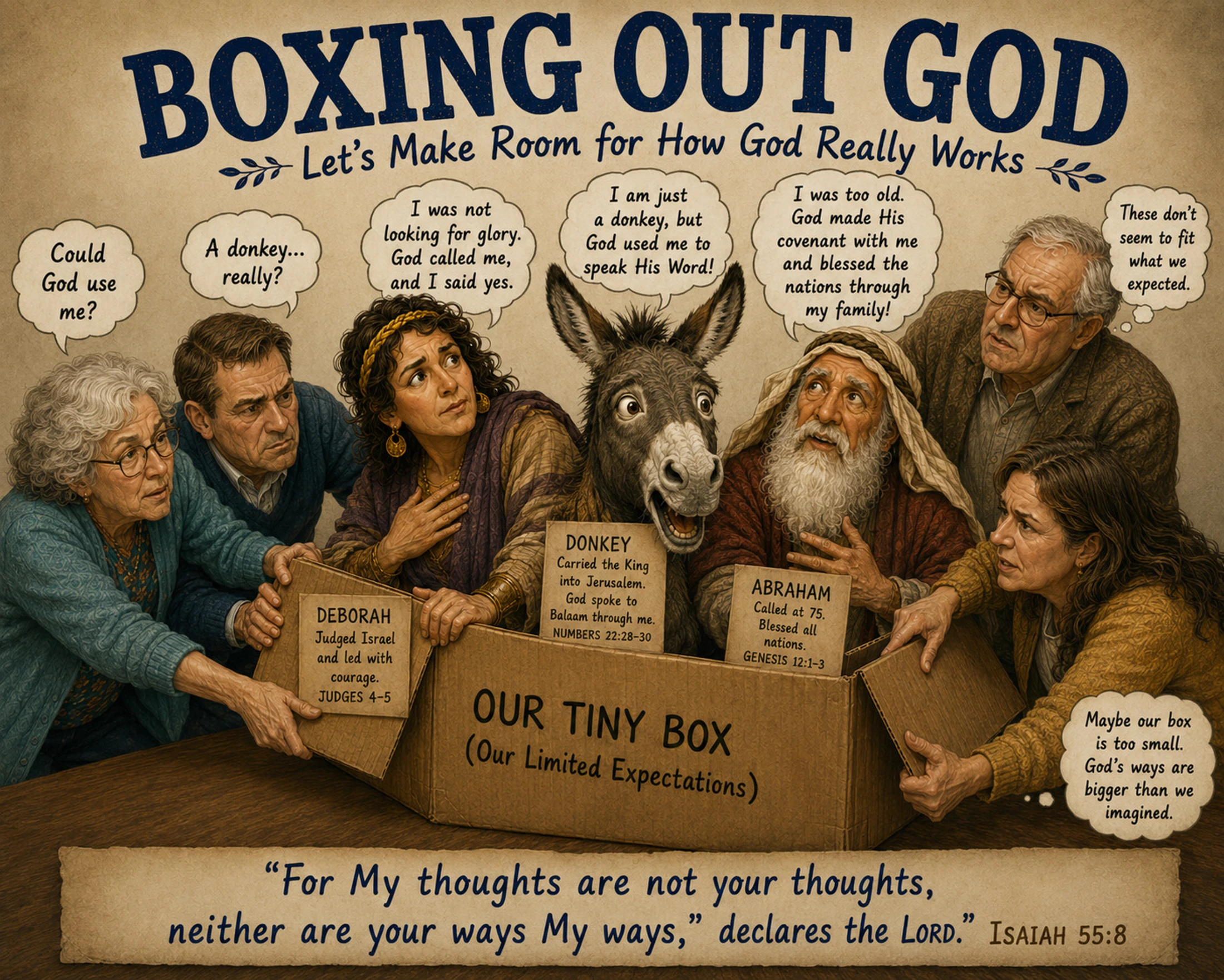
laugh at ourselves and our foibles. I hope you take the above cartoon in that
light and the exaggerated manner in which it is presented.
That being said. There is a fascinating pattern in Scripture that is no laughing matter
and should humble every one of us.
God establishes order.
Humans often turn order into rigidity.
Then God quietly steps around the walls we built and reminds us He is still God.
It happens over and over again.
We humans love systems. We love categories. We love predictability. We especially love
being able to say, “God always works this way.”
And then Deborah shows up.
Or Rahab.
Or Priscilla.
Or Phoebe.
And suddenly our neat little theological filing cabinets start rattling.
Now before someone grabs a pitchfork or drafts a twelve-page Facebook rebuttal BOLDED
AND IN ALL CAPS, let’s say something clearly and carefully:
Scripture absolutely teaches that God’s design for the home and the church is
intentional, orderly, and good. God is not confused about leadership,
authority, family structure, or church governance. His model is neither weak
nor outdated. It is wise because He is wise.
But the Bible also gives repeated warnings against treating God like He can only
operate inside our preferred expectations.
That is a dangerous habit.
For my thoughts are not your thoughts, neither are your ways my ways, declares the Lord.
For as the heavens are higher than the earth, so are my ways higher than your ways and my thoughts than your
thoughts.
~Isaiah 55:8–9 (ESV)
The same God who establishes patterns is also the God who occasionally shocks people by
working through the person everyone else overlooked.
And honestly? That should comfort us.
Because if God only used the polished, powerful, credentialed, predictable people… most of
us would be disqualified by Tuesday morning.
Deborah: The Judge Nobody Expected
In Book of Judges, Israel is spiritually drifting, morally unstable, and politically
chaotic. Men who should have been leading courageously often were not.
And into that mess steps Deborah.
Not accidentally.
Not apologetically.
Not as a divine afterthought.
But, as a rescuer.
A courageous leader.
As one with, dare I say, authority over men.
She is introduced as a prophetess and judge appointed by God Himself.
That fact should make us pause before making sweeping assumptions about what God can or
cannot do, especially in extraordinary moments.
Deborah does not erase God’s created order.
She does not abolish masculinity.
She does not wage war against men.
Instead, her life exposes something far more uncomfortable:
Sometimes the people who should be stepping up are not. Sometimes the most qualified to
speak for God is not the person we would expect.
And when that happens, God is fully capable of raising up whom He chooses.
That truth should not start an argument.
It should incite us toward repentance.
Rahab: The Woman Nobody Would Have Elected
If there were a “Least Likely to Be Used by God” category in Jericho, Rahab probably
wins by unanimous decision.
A Gentile.
A prostitute.
An outsider.
Yet God not only saves her…
He weaves her into the Messianic line itself.
Think about that.
The God of Israel inserts Rahab into the lineage leading to King David and ultimately to Christ.
Meanwhile, religious people often struggle to let someone new volunteer in the nursery if
they had a rough life ten years ago.
Rahab is a warning to every spiritually proud heart:
Never assume you know whom God can redeem, restore, and use.
He specializes in writing grace stories with people we would have quietly excluded
from the committee.
Priscilla: The Theologian in the Room
One of the most interesting moments in the New Testament involves Priscilla and her
husband Aquila correcting Apollos.
Apollos was brilliant. Eloquent. Learned.
But incomplete in his understanding.
And Priscilla is right there helping instruct him more accurately in the faith. It
is not by accident that her name appears first when introducing her and her
husband in Paul’s Epistles and Luke’s Book of Acts She was clearly well
educated in theology. Paul and Luke obviously respected her and her teaching,
so much so, as to allow her to correct and instruct Apollos in the right
theology of Christianity.
Notice the beauty of the moment:
No rebellion.
No power struggle.
No theatrical outrage.
Just wisdom.
Truth.
Discipleship.
Faithfulness.
Sometimes modern debates become so loud that we miss the actual biblical picture.
Godly women in Scripture are not portrayed as ornamental background decorations whose only
spiritual role is arranging casseroles and refilling coffee.
(Though let the record show: church potlucks would collapse into social anarchy without
them.)
Women in Scripture pray, teach, prophesy, disciple, lead ministries, preserve truth,
show courage, finance kingdom work, protect God’s people, and display
astonishing spiritual maturity.
The early church was filled with faithful women whose strength helped carry the Gospel
across the Roman world.
Ignoring that reality is not biblical conservatism.
It is selective reading.
Phoebe: Trusted With the Gospel
Then we meet Phoebe in Epistle to the Romans 16.
Paul commends her warmly and entrusts her with significant responsibility. In his
Epistle to the Romans, Paul introduces Pheobe as a Deaconess—διάκονος (diakonos)—at
the church in Cenchreae (7-10 miles from Corinth in Greece).
Many scholars believe Phoebe likely carried Paul’s letter to Rome itself.
Imagine that for a moment.
One of the greatest theological letters ever written may have been delivered and
explained by a faithful Christian woman.
That does not weaken Scripture’s teaching on church order.
It magnifies the reality that God gifts and uses women profoundly within His
Kingdom purposes.
And frankly, church history itself becomes almost impossible to explain apart from
faithful women who prayed, taught children, preserved homes, supported
missions, endured persecution, funded ministry, and quietly held churches
together when everyone else was falling apart.
Many churches today stand on the spiritual sacrifices of women nobody remembers
except God.
And He remembers.
The Real Danger: Putting God in a Box
The issue is not whether God has order.
He does.
The issue is whether we become so rigid in our systems that we stop seeing the living God
moving before us.
The Pharisees had categories too.
And many of them completely missed the Messiah standing right in front of them because He
did not fit their expectations.
That danger still exists.
Whenever we say:
“God would never…”
…we should probably lower our voice a little.
Because Scripture repeatedly demonstrates that while God never contradicts His
character, He often surprises human assumptions.
He used women.
He used shepherds.
He used fishermen.
He used foreigners.
He used barren women.
He used exiles.
He used tax collectors.
He used persecutors, murderers, and adulterers.
He even used a donkey once, which should encourage those of us in church
leadership everywhere.
The point is not that we should get comfortable with chaos.
The point is humility.
God is God.
We are not.
A Better Response
Perhaps the healthiest response is neither reactionary traditionalism nor modern rebellion.
Perhaps it is humble biblical faithfulness.
Hold firmly to what Scripture clearly teaches.
Honor God’s created order.
Reject cultural hostility toward masculinity and femininity alike.
But also leave room for awe.
Leave room for the possibility that God may use someone you underestimated.
Leave room for the Deborahs.
The Rahabs.
The Priscillas.
The Phoebes.
And maybe most importantly…
Leave room for God to be bigger than your categories.
Because throughout Scripture, one truth becomes impossible to miss:
God delights in using unexpected people to accomplish unmistakable glory.