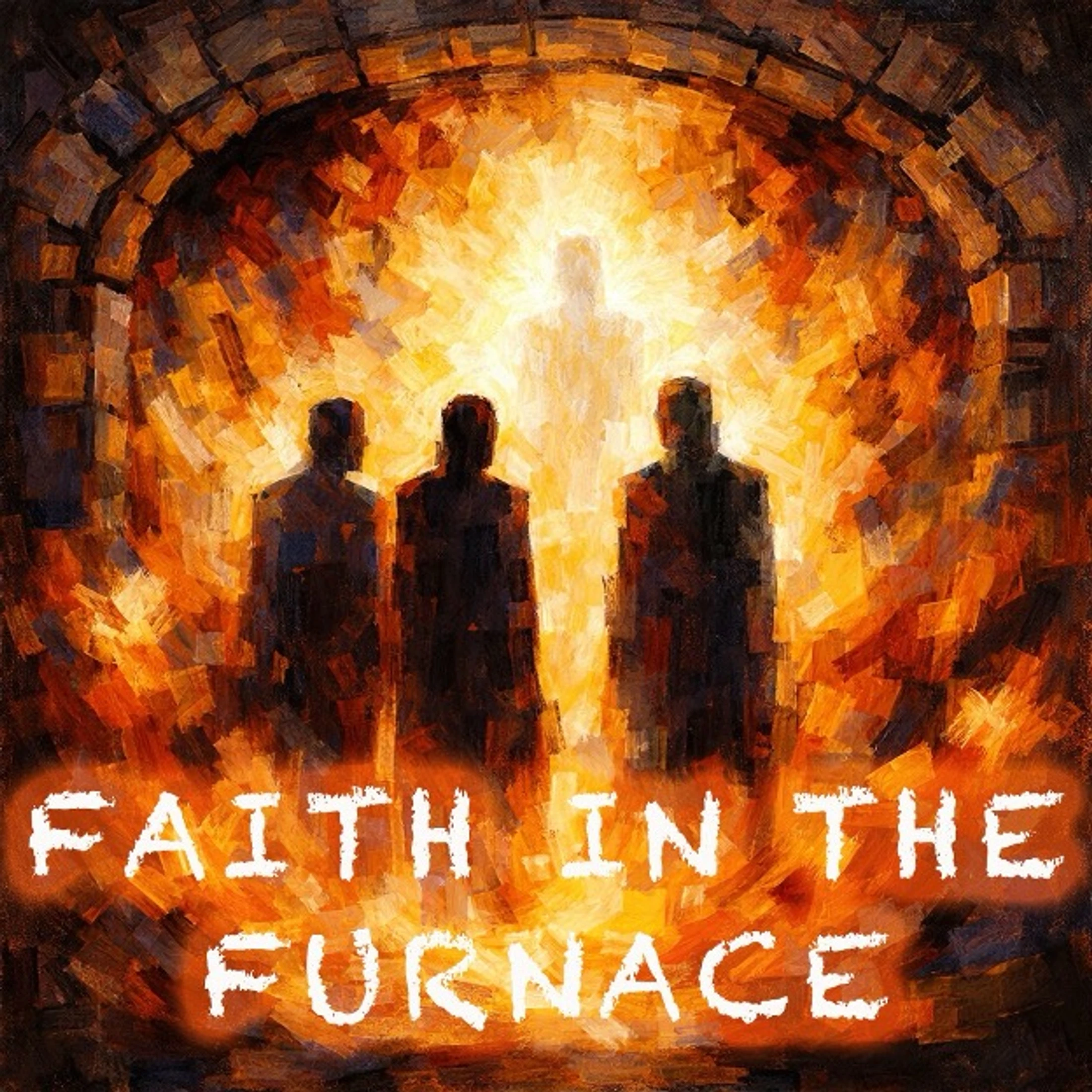
Faith In the Furnace
Dr. Jeff Webb
Most people assume faith should make life easier.
FollowGod. Trust Christ. Do the rightthings. Then life should be smooth as silk, right?
That assumption quietly slips into our thinking even if we would never say it out loud. But when we open the Bible, we quickly discover something that ushers us right back to Earth:
Faith never was meant to remove suffering. In some cases, it even invites it. And yet—here is the paradox of the Christian life—
the same faith that may lead us into suffering is also the faith that sustains us through it and
ultimately redeems it.
Scripture presents faith not as an escape from suffering, but as the lens through which suffering is viewed and transformed.
- Faith Can Lead Us Into the Furnace
Few stories illustrate this better than the account of Shadrach, Meshach, and Abednego in Daniel 3.
King Nebuchadnezzar erected a massive golden image on the plains of Dura and commanded that every person bow down and worship it. The punishment for refusing was terrifying: anyone who would not bow would be thrown into a blazing furnace.
When the king learned that these three Jewish men refused to bow, he summoned them and offered them one final opportunity.
Their response stands as one of the most remarkable declarations of faith in all of Scripture:
“If this be so, our God whom we serve is able to deliver us from the burning fiery furnace… and he will deliver us out of your hand, O king. But if not, be it known to you, O king, that we will not serve your gods or worship the golden image that you have set up.” (Daniel3:17–18)
Notice the strength of their faith.
They were confident that God could save them.
But their faith did not depend on whether He would.
Their trust in God was not conditional on their safety.
Even if the flames consumed them, they would still belong to Him. This is the essence of biblical faith.
Faith does not say, “God will always keep me from the fire.” Faith
says, “WhetherHerescuesmeornot,IwillstilltrustHim.”For these men, faith did not keep them out of the furnace. It led them straight into it.
And this pattern appears throughout Scripture.
Abel’s faith led to his murder (Heb. 11:4; Gen. 4:8). Noah’s faith made him the object of ridicule for decades.
Moses chose to suffer with God’s people rather than enjoy the comforts of Egypt (Heb. 11:24–
25).
Faith does not guarantee comfort.
But it does place us firmly—hear me now—FIRMLYin the hands of a faithful God.
- Faith Sustains Us in the Fire
Nebuchadnezzar, enraged by their refusal, ordered the furnace heated seven times hotter than usual. The flames were so intense that the soldiers who carried the men to the furnace were themselves killed by the heat (Daniel 3:22).
Then Shadrach, Meshach, and Abednego were thrown into the fire. But something astonishing happened.
A few moments later the king looked into the furnace and was stunned. Instead of seeing three men consumed by flames, he saw four men walking freely inside it.
“Did we not cast three men bound into the fire?”
“But I see four men unbound, walking in the midst of the fire, and they are not hurt; and the appearance of the fourth is like a son of the gods.” (Daniel3:24–25)
God did not keep them fromthe furnace. But He met them init.
When they came out of the fire, Scripture tells us that their hair was not singed, their clothes were not burned, and not even the smell of smoke clung to them (Daniel 3:27).
Their faith did not prevent the trial. But it sustained them within it.
This same sustaining faith appears again and again throughout the Bible.
The apostle Paul endured beatings, imprisonment, shipwreck, and persecution, yet he could still say:
“We are afflicted in every way, but not crushed; perplexed, but not driven to despair.” (2 Corinthians 4:8)
What allowed Paul to endure such hardship? Faith.
Faith allowed him to see beyond the immediate pain to a greater reality:
“For this light momentary affliction is preparing for us an eternal weight of glory beyond all comparison.”
(2Corinthians4:17)
Here’s the key: Faith reframes suffering.
Without faith, suffering feels random, pointless, and cruel.
But with faith, suffering becomes something different. It becomes a tool in the hands of God. As Paul reminds us:
“We know that for those who love God all things work together for good, for those who are called according to his purpose.” (Romans8:28)
Faith whispers in the darkest moments:
Godisstillhere.
Godisstillworking.
Godisnotfinishedyet.
- Faith Ultimately Triumphs
Perhaps the most beautiful truth in Scripture is this: suffering is never the final chapter for those who belong to Christ.
Faith looks beyond the present moment to the promises of God.
Hebrews tells us something remarkable about the faithful saints who suffered throughout history:
“These all died in faith, not having received the things promised, but having seen them and greeted them from afar.” (Hebrews 11:13)
Faith does not deny suffering.
Faith simply refuses to believe that suffering has the final word. The cross itself proves this.
On the day Jesus was crucified, it appeared that suffering had won. The Son of God hung on a cross, rejected and condemned.
But the resurrection revealed something entirely different.
What looked like defeat was actually the pathway to redemption.
Because Christ rose from the grave, every believer can know this certainty:
“The sufferings of this present time are not worth comparing with the glory that is to be revealed to us.” (Romans8:18)
Faith sees what is not yet visible. Hebrews describes it this way:
“Now faith is the assurance of things hoped for, the conviction of things not seen.” (Hebrews11:1)
And that means something profound for every believer. Faith that suffers is not a failure.
It is often the very place where God’s presence becomes most visible.
- Faith in the Furnace Still Wins
The world often defines victory by comfort, success, or visible outcomes.
But Scripture defines victory differently.
Victory is faith that refuses to let go of God. Even when life hurts.
Even when prayers seem unanswered. Even when the road is long and difficult.
The men who walked into Nebuchadnezzar’s furnace understood this.
They trusted that God could save them.
But even if the flames had taken their lives, they still would have belonged to Him. That is the kind of faith Scripture celebrates.
Hebrews says of those who endured suffering for the sake of God:
“The world was not worthy of them.” (Hebrews11:38)
Because faith knows something the world does not understand:
The furnace is temporary.
God’s promises are eternal.
And for those who belong to Christ, even faith that suffers ultimately wins.