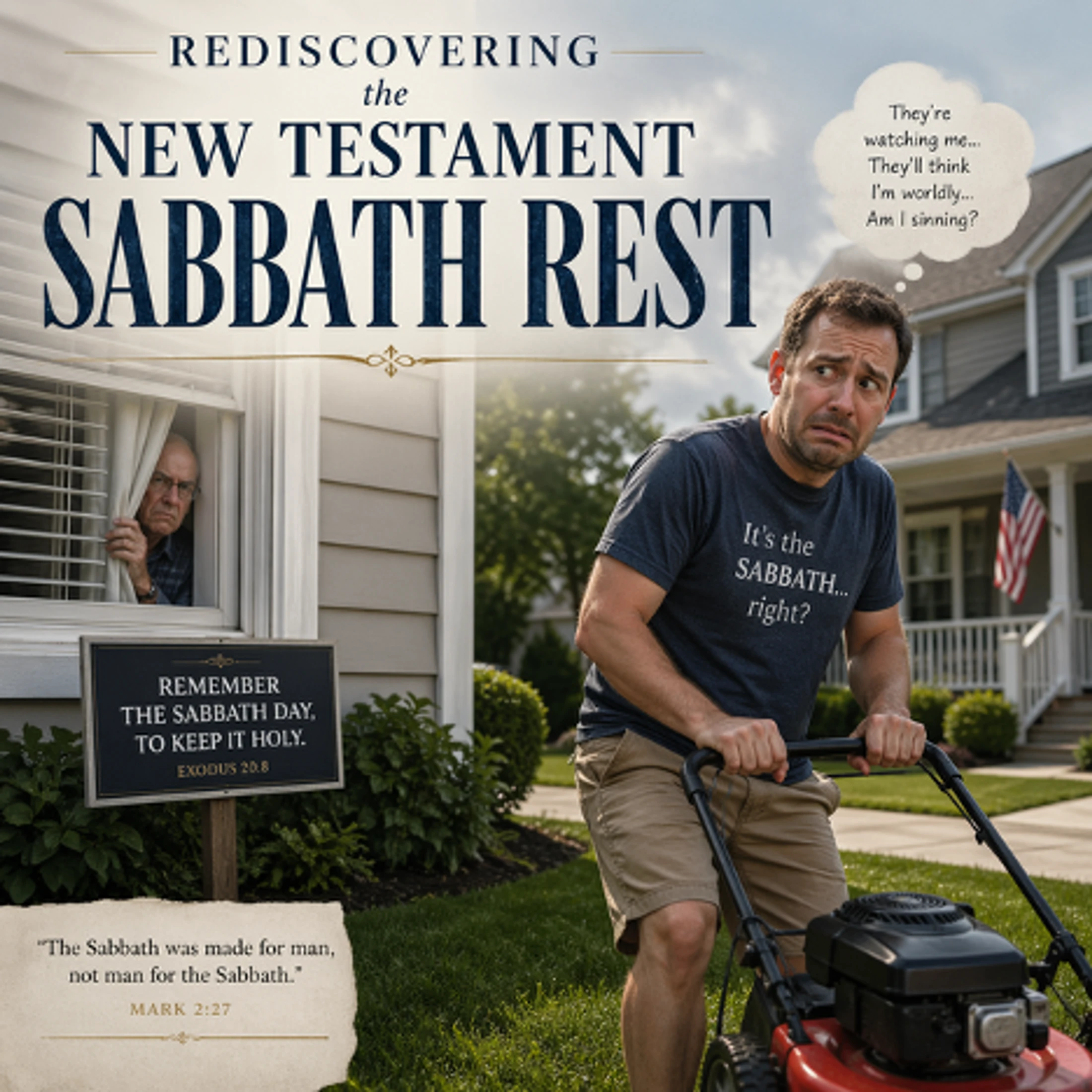
Rediscovering the New Testament Sabbath Rest
By Dr. Jeff Webb
I arrived home after my prayer and study leave to a
yard whose grass looked like it had grown a foot while I was away.
Meanwhile, every neighbor’s lawn stood neatly
trimmed—as if they had all coordinated their timing just to expose mine.
So there we were on Sunday—Bev and I—peering out the
window a bit sheepishly, wondering what would happen if I slipped outside and
quietly relieved our suffering.
But I just couldn’t bring myself to do it.
After all… what would the neighbors think?
A pastor… mowing his lawn… on the Sabbath?
It is that struggle that prompts this week’s Pause and Reflect.
There was a time when everything stopped.
Stores closed. Work ceased. Families gathered. The
rhythm of life slowed to a sacred hush.
Today?
We don’t stop—we scroll.
We don’t rest—we recover.
We don’t worship—we multitask.
And somewhere along the way, the Sabbath became…optional.
But according to God’s Word, the Sabbath was never
meant to be a burden—it was a gift.
1. The Sabbath Was Established by God—Not Man
The Sabbath is not a human tradition. It is woven
into the very fabric of creation.
In Genesis 2:2–3, God Himself rests on the seventh
day—not because He was tired, but because He was establishing a rhythm for
humanity.
“So God blessed the seventh day and made it holy…”
Before there was sin… before there was Israel…
before there was the Law… There was Sabbath.
2. The Sabbath Became a Covenant Sign for God’s People
When God gave the Law in Exodus 20:8–11, the
Sabbath was commanded as part of the Ten Commandments.
It wasn’t just about taking a break—it was about remembering:
• God is Creator
• God is Provider
• God is Lord of time
Later, in Exodus 31:13, the Sabbath is called a sign between God and His people.
In other words, how Israel rested revealed who they trusted.
3. Jesus Clarified the Heart of the Sabbath
By the time we reach the Gospels, the Sabbath had
been buried under legalism.
But Jesus Christ cuts through the
noise in Mark 2:27: “The Sabbath was made for man, not man for the Sabbath.”
He restores its purpose:
• Not oppression → but restoration
• Not ritual → but relationship
• Not restriction → but renewal
And then He makes a stunning claim:
“The Son of Man is Lord even of the Sabbath.”
4. The Early Church and the Shift to the Lord’s Day
After the resurrection, believers began gathering
on the first day of the week—the day Christ rose.
We see this in Acts 20:7 and 1 Corinthians 16:2.
This became known as “the Lord’s Day” (Revelation 1:10).
This wasn’t a rejection of Sabbath principles—it
was a fulfillment in light of the resurrection.
The focus shifted from:
• Creation → New Creation
• Rest after work → Rest in Christ’s finished work
5. Are Christians Required to Keep the Sabbath Today?
This is where clarity matters.
The New Testament does not command Sabbath
observance in the same way as under the Mosaic Law.
Colossians 2:16–17 says:
“Let no one pass judgment on you… with regard to a Sabbath.”
And Romans 14:5 adds:
“One person esteems one day as better than another,
while another esteems all days alike…”
So what does this mean?
• We are not under legal obligation to observe the Sabbath as Israel was
• But we are still invited into the principle of Sabbath rest
6. The Sabbath Principle Still Matters—Deeply
Even if the form has changed, the need has not.
We are still:
• Finite
• Dependent
• Easily distracted
• Spiritually dry without intentional rhythms
Ignoring rest doesn’t make you more productive—it makes you more fragile.
God’s design still stands:
• Work faithfully
• Rest intentionally
• Worship regularly
7. The Greater Sabbath: Rest for the Soul
Ultimately, the Sabbath points beyond a day.
In Hebrews 4:9–10:
“There remains a Sabbath rest for the people of God…”
This is fulfilled in Christ.
And Jesus Christ invites us:
“Come to Me… and I will give you rest” (Matthew 11:28).
This is the deeper reality:
• Rest from striving
• Rest from self-justification
• Rest from carrying what only God can carry
Living the Sabbath in the 21st Century
So what might this look like today?
Not legalism—but intentionality:
• Set aside regular time for worship (gather with the church)
• Build rhythms of rest into your week
• Disconnect from constant noise and productivity
• Recenter your heart on God’s Word
• Trust God enough to stop
This isn’t about rules.
It’s about reordering your life around what matters
most.
Let’s Pause & Reflect On This:
We live in a world that never stops—but God still says, “Be still.”
The question is not whether you can keep going.
The question is whether you trust God enough to stop.
Prayer
Abba,
You are the God who neither slumbers nor sleeps, and
yet You have called us to rest. Forgive us for living as though everything
depends on us. Teach us to trust You enough to stop striving, to quiet our
hearts, and to find our rest not just in a day, but in Your Son.
Reorder our lives around Your truth, and restore to
us the gift we have neglected. Amen.