The Bible We Shelved
The Bible We Shelved: Why We Shouldn’t Call Ourselves New Testament Christians
By Dr. Jeff Webb
“You know, I think a lot of Christians secretly treat the Old Testament like that treadmill we bought during the pandemic. We thought it would change our lives. We told everyone about it. And now it’s just sitting in the corner, holding laundry. We don’t get rid of it—we still respect it—but we also don’t use it.
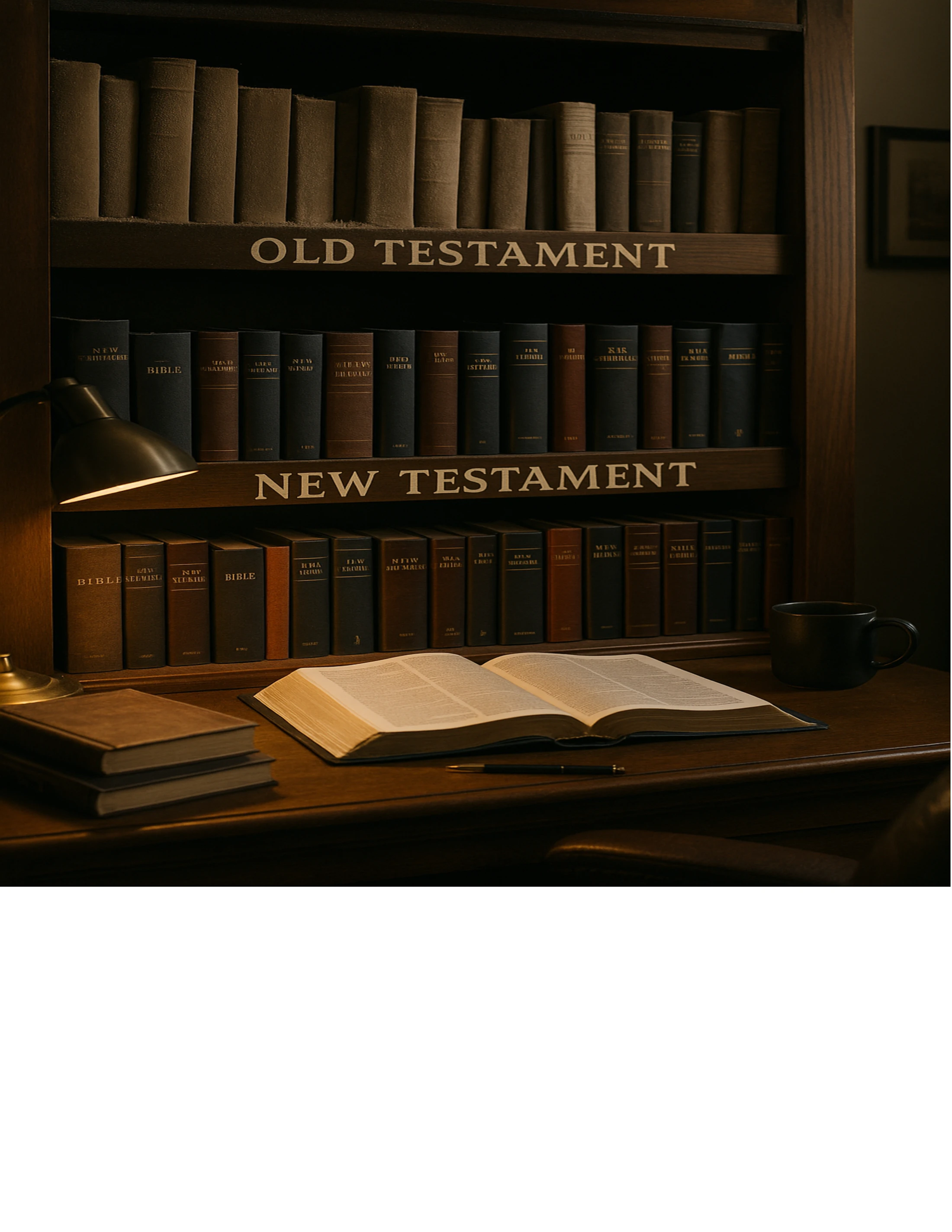
That’s kind of how the church treats the first thirty-nine books of the Bible. We know they’re important, but honestly… they’re intimidating. Lots of laws, lots of names, lots of sacrifices. And somewhere along the way, we quietly moved on to the New Testament and said, ‘This is easier.’
But here’s the problem: Jesus and the Apostles didn’t see it that way. They quoted the Old Testament constantly, lived in it, preached from it, and used it as the foundation for everything in the new covenant. And if it was essential for them, it’s essential for us.”
But here’s the uncomfortable truth: the New Testament church has, in many ways, abandoned the Old Testament. We’ve trimmed the roots and wonder why the tree of faith sometimes looks fragile. Yet Jesus and the Apostles leaned heavily on those very roots to announce the gospel and explain the new covenant. If the first-century church needed the Old Testament, can the twenty-first-century church do without it?
The Old Testament as Jesus’ Bible
When Jesus opened the scroll in the synagogue of Nazareth (Luke 4:16–21), He read from Isaiah 61: “The Spirit of the Lord is upon me…” This was not a passing reference. It was His mission statement, the foundation of His public ministry. Later, when He faced temptation in the wilderness, every reply to Satan came directly from Deuteronomy (Matt. 4:4, 7, 10).
Think about that. The Son of God, the Living Word, defeated the evil one not by inventing new words, but by leaning on words already given. If Jesus Himself lived by the Old Testament, how can we live as though it’s optional, or worse yet, obsolete?
Even the Sermon on the Mount, so often quoted as Jesus’ fresh ethic, is steeped in Old Testament law. “You have heard that it was said…” was not a dismissal but a fulfillment (Matt. 5:17). He did not abolish the Law and the Prophets—He fulfilled them. To ignore what He fulfilled is to miss the depth of what He accomplished.
The Apostles’ Preaching Was Rooted in the Old
Peter’s sermon at Pentecost (Acts 2) is an Old Testament survey wrapped in gospel fire. He quotes Joel 2, Psalm 16, and Psalm 110, showing how the resurrection of Jesus fulfills the promises given to David. Paul, standing in synagogues from Antioch to Corinth, reasoned from the Scriptures (Acts 17:2)—and at that point, the “Scriptures” were Genesis through Malachi.
Even the bold declaration of salvation by grace through faith (Hab. 2:4, cited in Rom. 1:17; Gal. 3:11; Heb. 10:38) is not a Pauline invention but an Old Testament anchor.
The Apostles did not see the Old Testament as a dusty prelude. They saw it as a living witness, fulfilled in Christ, necessary to prove the truth of the gospel. To unhitch the New from the Old, as some modern voices have suggested, is to cut the Apostles off from the very Scriptures that gave them authority.
Why the Church Has Drifted
So why has the modern church pushed the Old Testament into the margins? A few reasons come to mind.
1. Misunderstanding of Law and Grace.
Because Paul is so clear that we are not justified by works of the law (Gal. 2:16), we assume the law itself is a problem. But Paul also says the law is holy, righteous, and good (Rom. 7:12). The issue is not the law—it is our sin. By ignoring the law, we miss the character of God revealed through it and the holiness He still calls us to embody.
2. The Complexity of Ancient Texts.
Let’s be honest: genealogies, sacrificial regulations, and prophetic oracles are not easy reading. Preachers may shy away from Leviticus or Ezekiel, for example, because the cultural distance feels too wide. But avoiding difficulty has never been the path of discipleship. The hard soil of the Old Testament often hides the richest treasures.
3. The Rise of a “Red-Letter Only” Christianity.
Some well-meaning believers suggest we should focus on the words of Jesus alone, as though His words exist apart from the Scriptures He quoted. But when Jesus Himself said, “Man shall not live by bread alone, but by every word that comes from the mouth of God” (Matt. 4:4), He was quoting Deuteronomy. To pit Jesus’ words against the Old Testament is to misread His own teaching.
What We Lose Without the Old Testament
When the church neglects the Old Testament, we lose more than a history book. We lose the very categories that make the gospel intelligible.
• Without the law, we cannot grasp the weight of sin or the holiness of God.
• Without the sacrifices, we cannot appreciate the finality of Christ’s cross.
• Without the prophets, we cannot see the long-suffering patience and covenant love of God.
• Without the promises to Abraham, David, and Israel, we cannot rejoice fully in the inclusion of the Gentiles.
The New Testament is not a standalone document. It is the climactic chapter in a story that began long before Bethlehem and Golgotha. To read it in isolation is like starting a novel on the last page and pretending you know the plot.
A Call to Re-Engage
What might happen if the church reclaimed the Old Testament as our indispensable foundation?
• Our preaching would deepen. Instead of recycling inspirational clichés, pastors would draw from the vast landscape of God’s dealings with His people—stories of covenant, failure, redemption, and hope.
• Our worship would expand. The psalms would again become the prayer book of the church, giving voice to both our laments and our praise.
• Our witness would strengthen. In a culture suspicious of novelty, we could show that the gospel is not a new fad but the fulfillment of ancient promises.
Most of all, we would discover anew the God who is the same yesterday, today, and forever. The God who spoke at Sinai is the same God who spoke on the Mount of Beatitudes. The Lamb slain before the foundation of the world was foreshadowed in every spotless sacrifice laid on Israel’s altars.
Living as New Covenant People with Old Covenant Roots
We are not called to go back under the law. Hebrews is clear: the priesthood, the sacrifices, the temple—all have found their completion in Christ. But completion does not mean irrelevance. Instead, it means the Old Testament has become the backdrop that makes the new covenant shine in full color.
To be new covenant Christians without Old Testament roots is to be like a tree without soil. It may look healthy for a season, but eventually the nourishment runs out. Jesus and the Apostles didn’t just quote the Old Testament—they lived in it, prayed through it, and preached from it. If they needed it, so do we.
Conclusion
The Old Testament is not an outdated manual. It is the very Word of God, pointing us to His Son, grounding us in His holiness, and reminding us that salvation has always been by grace through faith.
Perhaps the time has come for the modern church to dust off those pages, to teach them with fresh eyes, to sing their songs, and to stand in awe of the God who has revealed Himself across both covenants.
After all, we are not just “New Testament Christians.” We are whole-Bible people, chosen in Christ, rooted in Abraham’s faith, heirs of David’s promise, and empowered by the Spirit of the risen Lord.
May we never again abandon what Jesus and the Apostles cherished as the very foundation of our faith.