The Inspired Bible
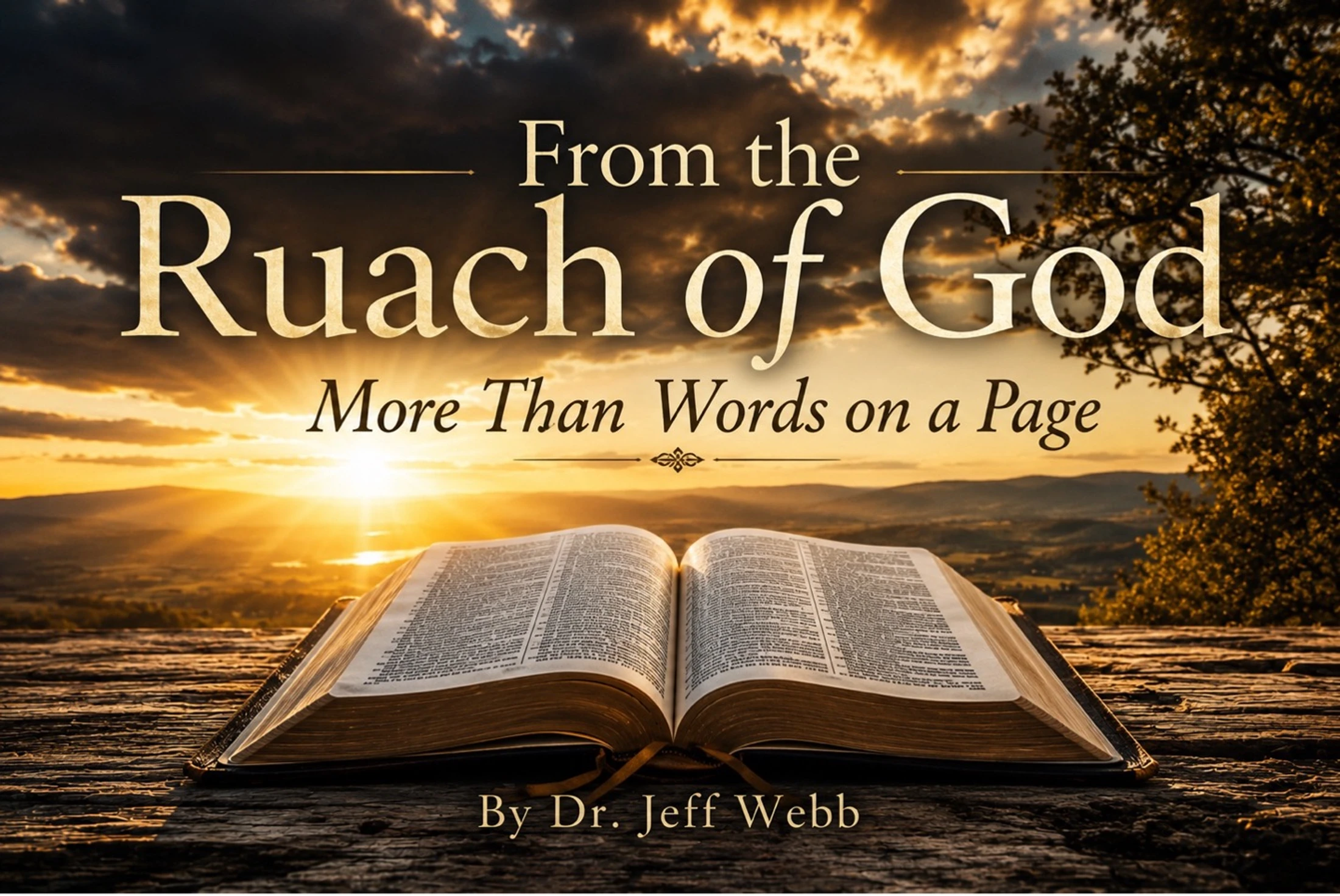
By Dr. Jeff Webb
The Hebrew word often translated “Spirit” in the Old Testament is the word ruach (רוּחַ). It is a wonderfully rich word that can mean breath, wind, or spirit depending on the context. From the opening verses of Genesis, we are told:
“The earth was without form and void, and darkness was over the face of the deep. And the Spirit of God was hovering over
the face of the waters.”
— Genesis 1:2 (ESV)
The phrase “Spirit of God” there is Ruach Elohim—the breath, wind, or Spirit of God moving over creation itself.
Later, the Hebrew expression Ruach Ha’Kodesh literally means “The Holy Spirit” or “The Holy Breath.” Throughout Scripture, the imagery of God’s Spirit is deeply connected to life, movement, revelation, and divine presence. God breathes life into Adam. God’s Spirit empowers prophets. God’s Spirit inspires Scripture. And ultimately, God’s Spirit awakens hearts to understand Him personally.
Perhaps that imagery is intentional and profoundly beautiful.
The Bible is not merely ink on paper; it is the product of the very breath of God moving through human lives across generations. Scripture carries the fingerprints of its human authors, yet behind it stands the living Ruach Ha’Kodesh—the Holy Spirit—guiding, inspiring, convicting, and revealing the heart of God to humanity.
Few subjects have generated more discussion throughout Christian history than the authorship of Scripture itself. With the possible exception of the creation account in Genesis, and the death and resurrection of Jesus, it is likely that no other topic has been more examined, debated, defended, and reflected upon more deeply.
How exactly did God give us His Word?
Did He dictate every sentence mechanically?
Did the writers simply record their own thoughts?
How could Scripture be both divine and yet so unmistakably human?
The Bible itself gives us the answer—not in exhaustive technical language, but in beautiful theological clarity.
Paul writes:
“All Scripture is breathed out by God and profitable for teaching, for reproof, for correction, and for training in righteousness.”
— 2 Timothy 3:16 (ESV)
Scripture is “God-breathed.”
Inspired.
Not merely human reflection.
Not merely religious philosophy.
Not merely moral storytelling.
And yet, at the same time, God chose to deliver His revelation through ordinary human beings whose personalities, emotions, education, culture, and life experiences remain visible throughout the pages of Scripture.
Moses writes with the weight of leadership and wilderness wandering.
David pours poetry from both joy and heartbreak.
Jeremiah sounds wounded and burdened.
Luke writes with the precision of a careful historian.
Paul reasons like the highly educated rabbi he was.
John writes with awe and wonder about the majesty of Christ.
The humanity of the authors was not erased.
It was used.
The Apostle Peter explains it this way:
“For no prophecy was ever produced by the will of man, but men spoke from God as they were carried along by the Holy Spirit.”
— 2 Peter 1:21 (ESV)
What a remarkable phrase:
“carried along by the Holy Spirit.”
God did not bypass humanity in order to reveal Himself.
He worked through it.
And perhaps that is part of the brilliance of God’s design.
The Lord could have written every page personally upon stone tablets, just as He did with the Ten Commandments. Exodus 31:18 says:
“And he gave to Moses, when he had finished speaking with him on Mount Sinai, the two tablets of the testimony, tablets of stone, written with the finger of God.” (ESV)
But that is not how He chose to give us most of Scripture.
Instead, He gave us a living narrative unfolding across centuries through prophets, kings, fishermen, shepherds, and apostles. He allowed His revelation to move through real lives and real experiences so that we might not merely collect information about Him, but come to know Him personally.
That distinction matters.
The Bible was never intended to become merely an academic exercise.
It is possible to study Scripture and yet miss the heart of God entirely.
Jesus confronted the religious leaders of His own day with these sobering words:
“You search the Scriptures because you think that in them you have eternal life; and it is they that bear witness about me.”
— John 5:39 (ESV)
They knew the text.
But they missed the Savior to whom the text pointed.
That danger still exists today.
We live in a world overflowing with Bible access. We carry multiple translations on devices in our pockets. We listen to sermons, podcasts, debates, reels, and teachings almost endlessly.
And yet many believers still struggle to truly know God intimately.
Why?
Because Scripture was never meant to function apart from the work of the Holy Spirit.
Before His crucifixion, Jesus made an astonishing promise to His disciples. Knowing that He would soon ascend back to the Father, He told them they would not be abandoned alone.
John 14:16–17 says:
“And I will ask the Father, and he will give you another Helper, to be with you forever, even the Spirit of truth.”
— John 14:16–17 (ESV)
Then again in John 16:13, Jesus says:
“When the Spirit of truth comes, he will guide you into all the truth.”
— John 16:13 (ESV)
What a profound reality.
God not only inspired His Word through the Holy Spirit, but He also gave His Holy Spirit to help illuminate that Word within us.
The same Spirit who carried along the writers of Scripture now works within believers to convict, guide, comfort, teach, and transform.
That does not mean every difficult passage suddenly becomes simple or that Christians instantly possess all understanding. Some portions of Scripture remain challenging, deep, and worthy of lifelong study. Even Peter acknowledged that some of Paul’s writings were “hard to understand” (2 Peter 3:16).
But it does mean that God never intended His Word to be approached merely as literature detached from relationship.
Scripture is living because God is living.
Hebrews 4:12 reminds us:
“For the word of God is living and active, sharper than any two-edged sword.”
— Hebrews 4:12 (ESV)
The Bible is not magical ink on paper.
It is the Spirit-inspired revelation of the living God inviting us into fellowship with Him.
And perhaps this is where the beauty of faith enters the story.
God has made Himself wonderfully accessible, yet He still calls us to trust Him.
There remains an invitation.
A response.
A willingness to seek Him sincerely.
Faith is not blind irrationality. Nor is it the absence of evidence. Rather, faith is the humble willingness to trust the God who has revealed Himself through creation, through Scripture, through Christ, and through the quiet work of the Holy Spirit within our hearts.
Hebrews 11:1 says:
“Now faith is the assurance of things hoped for, the conviction of things not seen.”
— Hebrews 11:1 (ESV)
God could overwhelm humanity with raw, undeniable force every moment of every day.
But instead, He lovingly invites us into relationship.
He calls us to seek Him.
To walk with Him.
To listen.
To grow.
To trust.
And in doing so, our faith becomes deeply personal rather than merely intellectual.
Perhaps that is part of God’s magnificent wisdom in how He revealed Himself.
He did not simply hand us information.
He invited us into communion.
The Scriptures point us toward Christ.
The Holy Spirit illuminates truth within us.
And through both, God forms a living relationship with His people.
That relationship changes everything.
The Bible ceases to become merely a book we read occasionally and instead becomes the place where we encounter the heart of God.
Its words confront us.
Comfort us.
Convict us.
Strengthen us.
Transform us.
Not because ink alone possesses power, but because the living God continues to speak through the Word He inspired and the Spirit He sent.
So perhaps the question is not simply whether we own a Bible, study theology, or attend church regularly.
Perhaps the deeper question is this:
Are we allowing the Holy Spirit to lead us into truth and into a genuine relationship with the God who revealed Himself through His Word?
Because God did not merely write a story.
He lovingly introduced Himself.